You know that you're in a bad neighborhood when you wake up in the morning and you find your submarine up on blocks.
Battleship Park in Mobile, Alabama doesn't just have a battleship...They have this wonderful Gato-class fleet boat: USS Drum (SS-228).
Last time I saw Drum, she was still in the water. But two hurricanes and seventy+ years since her last war patrol have done a number on her, so now she's up on these concrete supports.
If nothing else, she's safer here...and visitors get a great look at her props and rudder as well as her stern tubes.
Up on deck, she's looking good. Got a 3"/50cal. deck gun and a 40mm Bofors Anti-aircraft gun forward.
There's also a 20mm Oerlikon gun on the after deck of the conning tower.
Going down through the old torpedo loading hatch brings you into the forward torpedo room, with six of her ten tubes await fresh fish. Back in the day, these subs sailed with 24 torpedoes, sixteen up front here and eight in the aft torpedo room where she had four tubes. Several of the crew got to bunk in these compartments too, sleeping above and below the torpedoes.
Leaving this compartment via this hatch, you find yourself in the forward section known as "Officer Country".
Here's the Officers' Wardroom.
Officers slept two and three to a small compartment except for the Captain, who got his own small compartment. Since they were all glassed over and the corridor itself was cramped, I couldn't get an angle to take a good shot of any. I did find this memorial to Howard Gilmore though.
Commander of Growler, he was machine-gunned on the bridge and wounded during a surface action in which Growler had rammed a Japanese vessel and destroyed 18 feet of her own bow. In the heat of battle he gave the order to dive, knowing he couldn't get off the bridge. The sub dove away beneath him and was saved, but Commander Gilmore was lost. He sacrificed himself for his boat and crew. Now there was a MAN. And yes, he was awarded the Medal of Honor...posthumously.
Another hatch...and the control room beyond.
Control room.
Helm (or "steering wheel" to civilians, landlubbers and brown shoe types.)
Diving planes. These control the pitch of the bow and stern.
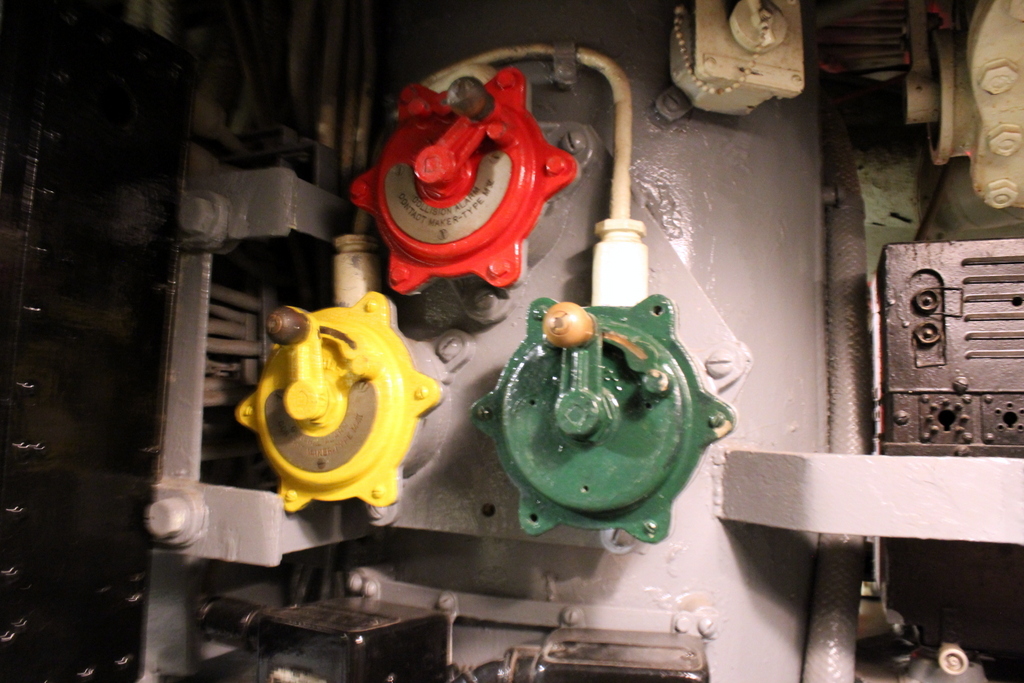
Alarm switches. (Hey Old AF Sarge...remember these?)
"Christmas Tree" board, with two lights for every hatch and vent. Green meant closed and red meant open. Gotta have a whole green board to dive, meaning a lot of people in different areas have to work fast to close a lot of things off when the dive horn sounds.
Helm again, and plotting table.
And because I'm retarded or something, I got no pictures of the crew's mess. But click on submarines here to see pics of the insides of several other fleet boats that are laid out pretty much the same.
Cold storage beneath the crew mess.
Next was a bunk space for much of the enlisted crew--just stacks of racks--but most of them were out for some display stuff. Again, no pics for some reason. But then it was tie for the two engine rooms, and I like to think I made up for it.
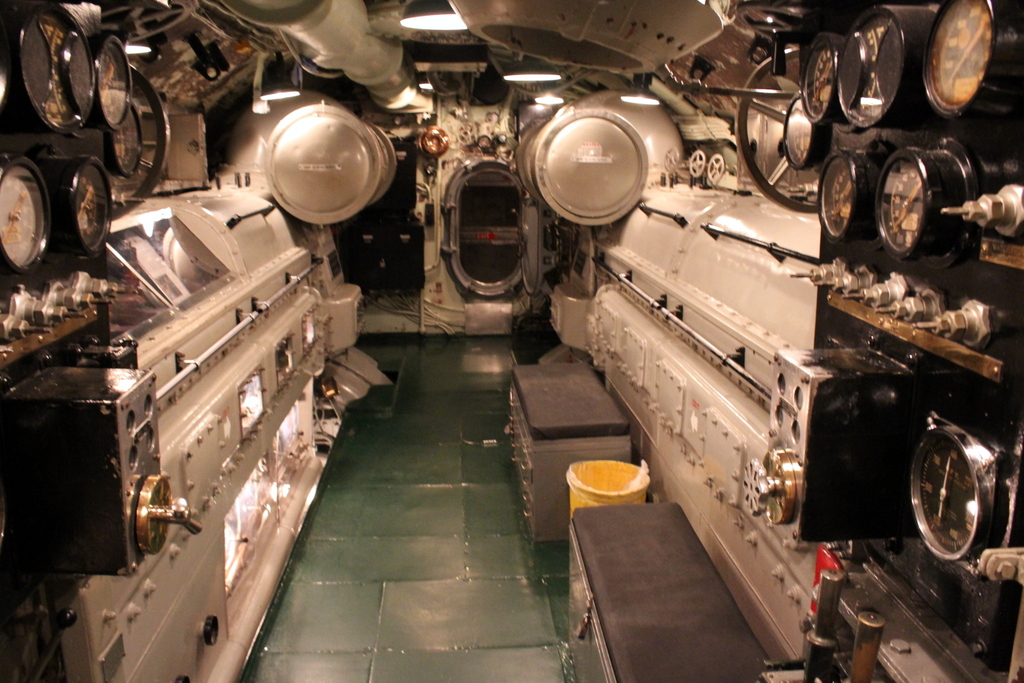
Four Fairbanks-Morse engines, originally designed for railroad locomotives. These two are in the forward engine room.
And this hatch leads to the after engine room.
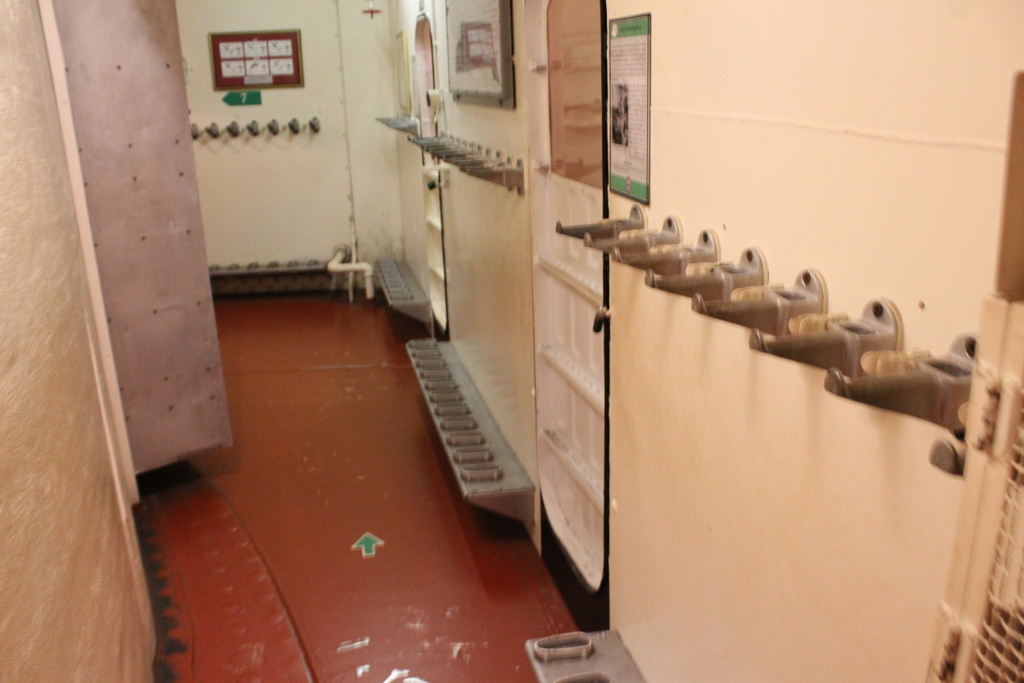
Each crew member got one locker like this for all of their stuff--spare uniforms, personal effects--everything.Through another hatch, and you're in the electrical compartment.
It's back here that power is shunted from the four big diesels up front to either the battery chargers that put power into the 252 batteries below the decking or to the two electric motors that actually turn the propellers (or a combination of both). That's right--those four huge diesels just generate electricity for the electric motors that actually turn the screws. On the surface, the electric motors take their power fro the diesels. Underwater, they get it from the batteries. But either way, the subs motors are electrically driven. And here's the panel where it's routed.
By the way--this area and the engine rooms were so loud that most crew members who served in them suffered permanent hearing loss to some extent.
Next we come back to the aft torpedo room. These subs could and did fire shots from both ends.
And how is this for tight rack space?
USS Drum. A great memorial to the heroes of the "Silent Service".
Go to Battleship Park and see her if you're in the area. And let me know--I may just join you.
Showing posts with label Battleship Park. Show all posts
Thursday, April 20, 2017
Monday, April 17, 2017
USS Alabama, Part 3
A couple of the 5"/38cal. twin mounts. They could be used for anti-aircraft defense or shore bombardment. This gun was the same as the main gun on a Destroyer of that era. Destroyers usually had five. Alabama has twenty.
During one particular battle on February 21, 1944, 5" gun mount 9 accidentally fired into 5" gun mount five, killing five and wounding eleven.
Inside of one of the 5" mounts. Tight in there for sure.
Spare 40mm AA gun barrels stored below decks against one of the main gun barbettes.
They cut an access portal into one of the barbettes so people could see what it was like inside. Back in the day, the only way into or out of this space was down through the turret. It was done like that to keep fires and explosions contained.
As stated before...been here on another battleship once. Looked like this, but wasn't nearly as clean. But then that one never had been open to the public and likely never will be. (Not my fault they didn't lock it up very well.)
16" shells. A lot of them.
I wonder how much Varget I'd need to sneak aboard to fire just one?
One compartment is a memorial to Senator Jeremiah Denton, Retired Admiral, naval aviator, ex-POW and all-around great American.
His name has been mentioned on this blog before. And I have his book. It was an honor to be in his space aboard Alabama.
During one particular battle on February 21, 1944, 5" gun mount 9 accidentally fired into 5" gun mount five, killing five and wounding eleven.
Inside of one of the 5" mounts. Tight in there for sure.
Spare 40mm AA gun barrels stored below decks against one of the main gun barbettes.
They cut an access portal into one of the barbettes so people could see what it was like inside. Back in the day, the only way into or out of this space was down through the turret. It was done like that to keep fires and explosions contained.
As stated before...been here on another battleship once. Looked like this, but wasn't nearly as clean. But then that one never had been open to the public and likely never will be. (Not my fault they didn't lock it up very well.)
16" shells. A lot of them.
I wonder how much Varget I'd need to sneak aboard to fire just one?
One compartment is a memorial to Senator Jeremiah Denton, Retired Admiral, naval aviator, ex-POW and all-around great American.
His name has been mentioned on this blog before. And I have his book. It was an honor to be in his space aboard Alabama.
Saturday, April 15, 2017
USS Alabama Part 2
Time to go inside.
Officers' wardroom.
Nice, eh? The 2,200 enlisted men and Marines didn't quite have it this posh.
Enlisted crew got their food here.
And slept in compartments like this all throughout the ship.
Typical corridor aboard. How can a ship this big be so darn small inside?
Navy ship vets should recognize this. They let emergency power cables pass through bulkheads it the main power is out. They're everywhere.
Armored door to fighting bridge. That's some heavy steel there. Designed to protect the helmsman and other crew essential to conning the ship in combat.
Inside:
Normally, the ship was conned from this bridge.
A trunk with ladders going somewhere interesting. But alas...
Ladders that we could and did use. Sadly, lotsa fat tourists seemed unclear on the concept of going UP ladders on one side of the ship and DOWN ladders on the other.
And the radio space...for Dr. Jim.
It was glassed in and that messed up some of my shots. Sorry.
The machine shop. A ship like this had to make any new parts or other gear that it needed at sea.
Armored deck.
Marine area rifle racks. Alas, no rifles.
This ship was home to several notables.
And Bob Feller, baseball great.
Like Ted Williams, when his nation called, he put his baseball career on hold and enlisted.
No access to boilers or machinery spaces below. That was a bit of a let down. I'm sure that those spaces are epic.
But you do get considerable access to the superstructure, especially if ladders are your thing.
More later...I sense French Quarter damsels pondering my whereabouts.
Officers' wardroom.
Nice, eh? The 2,200 enlisted men and Marines didn't quite have it this posh.
Enlisted crew got their food here.
And slept in compartments like this all throughout the ship.
Typical corridor aboard. How can a ship this big be so darn small inside?
Navy ship vets should recognize this. They let emergency power cables pass through bulkheads it the main power is out. They're everywhere.
Armored door to fighting bridge. That's some heavy steel there. Designed to protect the helmsman and other crew essential to conning the ship in combat.
Inside:
Normally, the ship was conned from this bridge.
A trunk with ladders going somewhere interesting. But alas...
Ladders that we could and did use. Sadly, lotsa fat tourists seemed unclear on the concept of going UP ladders on one side of the ship and DOWN ladders on the other.
And the radio space...for Dr. Jim.
It was glassed in and that messed up some of my shots. Sorry.
The machine shop. A ship like this had to make any new parts or other gear that it needed at sea.
Armored deck.
Marine area rifle racks. Alas, no rifles.
This ship was home to several notables.
And Bob Feller, baseball great.
Like Ted Williams, when his nation called, he put his baseball career on hold and enlisted.
No access to boilers or machinery spaces below. That was a bit of a let down. I'm sure that those spaces are epic.
But you do get considerable access to the superstructure, especially if ladders are your thing.
More later...I sense French Quarter damsels pondering my whereabouts.
Labels:
Battleship Park,
military,
ships,
USS Alabama
Subscribe to:
Posts (Atom)