Showing posts with label Gettysburg. Show all posts

Wednesday, April 29, 2015

Winged Wednesday

Because it's been far, far too long.
Heading east, following the Potomac River through the gap at Harpers Ferry.
Looking down on the historic Hilltop House hotel, once a luxurious inn with a view of the river to die for. Now it's just a ruin, and possiby too far gone to ever save.
Looking down on the Maryland side of the river at Harpers Ferry. Here you can see the two railroad lines converging at the mouth of the tunnel. Just before the tunnel, the tracks cross over the old C&O Canal. One of the old canal locks is visible, and alongside the lock is the remains of an old lock keeper's house. This one is notable in that one of John Brown's disciples , John Cook, took a job here as a lock keeper and schoolteacher in order to scout the armory before Brown's famous terrorist attack.
Here's the Blue Ridge, heading south into Virginia.
And out the other side, we see it going north, well into and through Maryland.
Railroad yard in Brunswick, MD. Two diesel locomotives stand waiting by the remains of the old B&O roundhouse that, when it was still there, housed steam engines.
Somewhere in Maryland. Dude--you really should have covered that pool over the winter. Good luck with THAT this summer.
Clearview airport (2W2). I needed to land here again since the last time I came in, I scotched the approach, came in too hot, and had to use roughly 1830 feet of the 1835-foot runway to get down and stopped. I gotta do it again.
Much better. Actually didn't embarrass myself this time. And another reason I landed here is to look at all of the sad aviation relics that adorn this field. I call it "The airport of misfit planes".
This was once a Cessna 175.
Here's an Ercoupe that could use a bit of work before it's next annual.
Sad, neglected Taylorcraft Tripacer. Almost missed this one back in the weeds.
Poor Piper.
This is an M-Squared Breese-2. Looks old, but it was built in 2004.
A 1947 Aeronca Champ.
I stopped into the FBO and spent quite a bit of time talking to the nice old fellow who was running it for the day as a favor to the owner. He told me that neither the Champ or the Breese has flown in years. That's so damned sad. Airplanes need to fly, and when you don't love 'em or fly 'em, they just rot away. And this airport is littered with examples of that.

After chatting for half an hour, it was time to go. There's nothing like a flat, smooth runway, and this one is really nothing like a flat, smooth runway.
I flew north, shot a touch-and-go at Carroll County Airport. Last time I was there was October, 2014, when Stretch and I went there to see the B-17.

Nothing cool there today, so I was in and out, and over this piece of hallowed ground in short order.

Gettysburg. 8,900 men died here between July 1 and July 3, 1863, and 22,000 more were wounded.
Devil's Den below. Little Round Top is just yards to the east.
The large white monument to the right is the Pennsylvania Memorial, largest monument on the battlefield. North of it a bit, just up that road to the left, you'll see an obelisk. This marks the high-water mark of the battle ant the war; it's the point where Pickett's Charge was turned back after suffering appalling casualties. That failed attack is said to have broken the back of the Southern army.
Lotta blood on the ground down there. Lotta futures lost forever.
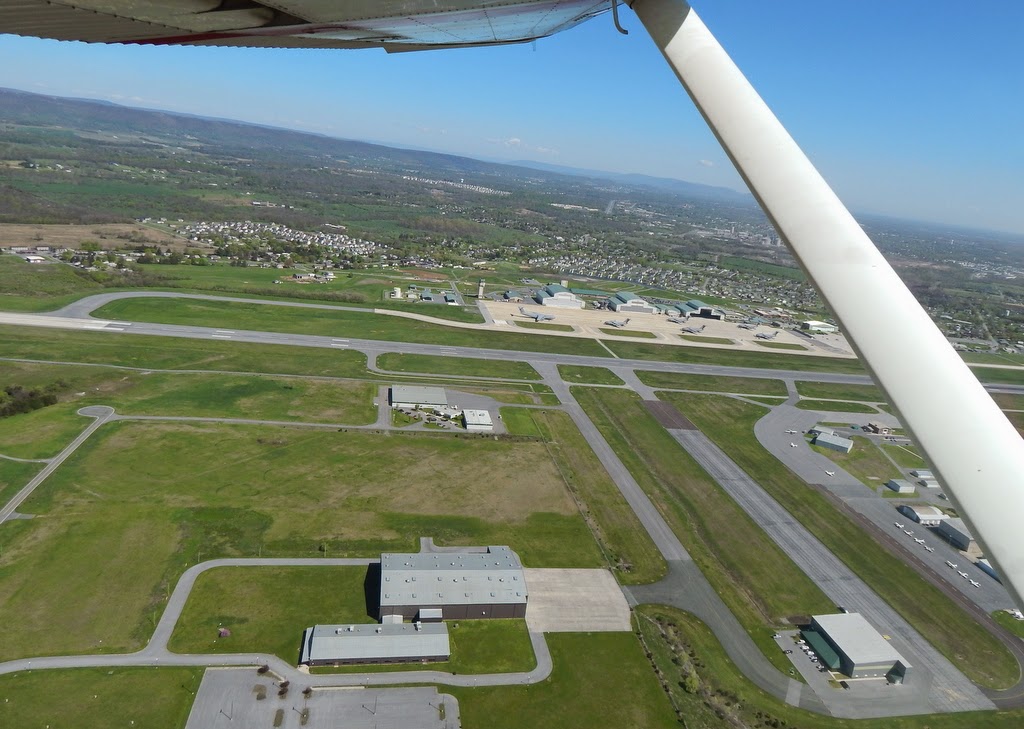
Next, it was a landing at Gettsyburg Airport (W05). I parked, got out to explore, then saw this neat Super Decathalon, grandson of that Champ back at Clearview, come in and land.
I tried to talk to the pilot when he walked up to the FBO, but for some reason, he was pretty dickish and blew me off. Seriously dude, you're flying a Citabria, not an SR-71. Put the attitude back in it's box.
Off again, and headed to Hagerstown, MD. Overflew this armory below, which was cool because artillery. It was allegedly Frederick the Great who once said that "Artillery brings dignity to what would otherwise be an ugly brawl." (Or it might have been Old NFO. Rumor has it that those two hung around a lot together.)

Into Frederick. Three other aircraft in the immediate area and I couldn't see any of them. This is one of those times when tower folks are actually useful and cool.
Back out of HGR and headed for home. Passed over Wiliamsport, MD and spotted Doubleday Hill below. This is where Union General Abner Doubleday (yeah, the baseball guy) commanded a detachment and built this small fortification atop this hill to cover the Ptomac River crossing below. If you click on the pic, you'll see three cannon below.
Finally, after four states, five airports and 2.3 hours of flying time, I'm home.
Monday, February 25, 2013

Flight mission: Gettysburg.

It was a nice, sunny, almost windless day, so what to do...what to do?


I took off, and made the turn out of the pattern, and a short distance out, I saw what I shall call "Bob's House of Junk" down below. (Click on the pictures to enlarge them.)


This is not unusual around here, being west Virginia and all, but that one red truck caught my eye--is it? Could it be?

Yep--a second pass confirms that the red pick-up truck in the yard is almost certainly an old M-715 one and a quarter ton military truck. I want it. Next free day, Ima gonna find Bob and make an offer on it. Unfortunately I was so busy trying to photograph it that I forgot to take a bearing on exactly where it was, so now when I get back to work and have a couple of free hours, I'll hit Google Earth and hunt for it.

Hey look--snow!

It's one of those places where people go to ski. Absent real snow, they make their own. Would that be faux snow?


Arriving at the object of today's mission, Gettysburg, Pennsylvania. The last time I was here, it was October of 2006 and I was just learning to walk with my then-new prosthetic foot. Aaron of the Shekel had come to visit and we went here where I immediately overdid it with the attempts at walking. But it was great all the same. Now I'm back, but in a plane. This is easier. With a right bank, I head south of town to take in the battlefield.

First thing I see is the old Cyclorama.
Little did I know when I took this that the historic building, vacant for years, is going to be razed this week.

Here's the monument to the dead of Pennsylvania. There are monuments to troops from every other state here, but this one is one of the largest and most ornate.


These are the fields that 12,000 Confederates under General Pickett marched across in an ill-thought-out attack on 7,000 Union troops on the other side known today as Pickett's Charge.

This charge, ordered by General Robert E. Lee, across three-quarters of a mile of open ground right into the muzzles of Union cannon and rifles, resulted in almost 50% casualties among the attacking force and was the turning point of the battle and the beginning of the end for Lee's attempt to take Pennsylvania and Maryland and ultimately, Washington DC itself.


The tall monument marks the High Water Mark, or the point that the battle turned as the Confederates were repulsed. The red barn beyond it is to Codori farm, which was there during the battle. It's estimated that over 500 Confederate dead were buried on the farm when the fighting was done.

Down below here is Devil's Den and Little Round Top above it. Some of the battle's most savage fighting too place here, with snipers nested in Devil's Den and artillery pieces on Confederate-held Round Top to the south and Little Round Top (shown here) which was held by the Union.

These are significant to me because I walked up Little Round Top on my own--the longest walk to date--when last here with the new foot. That's when I also learned that it's easy to walk up hills with a prosthetic foot, but much harder to walk back down, both owing to the fixed angle of the foot. I made it up just fine, but had to send Aaron back to get the car because I wasn't up to the walk back down yet.

I walk much better now. And I fly.

Cyclorama again.


The National Cemetery at Gettysburg.

8,900 men were killed in the three days of fighting here. It took ten days to find and bury them all, and that didn't include the horse carcasses.


And heading back west towards the airport, I pass over the Railroad Cut, where there was heavy fighting on the first day of the battle as Confederate forces attacked Union troops here, driving them from this ditch before being driven out again themselves later on.

The bones of a dead soldier last washed out of the side of this cut in 1996, a hundred and thirty three years after the fighting ended. No one could tell whose side he'd fought for but he was interred in the National Cemetery nonetheless.

I landed at the little airport west of town.


When I got there, the place was all locked up and empty. Not finding anyone, I left my plane in an out-of-the-way spot and walked into town to find lunch. A couple of guys at a nearby shop recommended the Sharpshooters Grille about half a mile away, so I went there.

You know it's a good bar if all of the school bus drivers are there. And they were. They had a great selection of beers, but alas, I could not have any because I was flying. The iced tea was ok, though.

Then it was back to the airport and off towards home.

On the trip home, I decided to do a touch-and-go at Hagerstown Regional Airport in Maryland, basically just because I didn't feel like detouring around their Class D airspace again. They cleared me for a touch-and-go and I shot it and moved on to the southwest, heading back home again.

Once back on the ground at my airport, I saw this cute little Cessna 150 getting gas.

It's just like an airplane, only smaller.

This one even has a name.


Then I watched them use a ground tug to push one of the C-5 Galaxy transports out of the massive hangar across the field.

Yeah, I need to get me one of those for my next plane. I wouldn't have to walk to restaurants when I fly into new airports because I could just take my truck with me.

Good day. I'm happy.

Saturday, October 28, 2006

Battlefield tours

Aaron and I managed to hit quite a few Civil War battlefield sites when he was here.
This was easy as there are many National Park Service Civil War battlefields around this area, a fact which caused Aaron to ask me why the Civil War armies chose to fight so many of their battles in National Parks.


On Monday, we went to Bolivar Heights, the hill above Harpers Ferry where Confederate General Stonewall Jackson captured 12,419 Union troops in 1862--the largest surrender of American fighting men that ever occurred until Corregidor fell during WW2.


Shown here is one of the cannon at Bolivar Heights. This is a Union gun--a 3" ordinance rifle that fired a ten pound cannonball. Cute little sucker, ain't it? Makes me wish I'd put that trailer hitch on my jeep. The Confederates captured 73 of these here along with their prisoners.

On Tuesday we went to Antietam. The battle here occurred just a few days after the stunning Confederate victory at Bolivar Heights. 23,000 men died in one day, making it the bloodiest day in American history. The Union victory here ended the Confederate invasion of the North.


This is the Lower Bridge over Antietam Creek, now known as "Burnside's Bridge" after Union General Burnside threw division after division of troops at it in a pathetically bungled attempt to capture it. The problem was that a line of about 450 Confederate riflemen were dug in on the hill just above it, and they shot down the Union soldiers as soon as they reached the bridge. The Federals finally took it but lost hundreds of men. Ironically they could have waded the creek anywhere and outflanked the Confederates easily if they hadn't been so fixated on taking the bridge itself by frontal assault.

But on this day, there was one Federal on the bridge with a gun. That was me with my Glock. And I was getting sore from a long crutch-walk to and across it. But it was good.

On Thursday, Aaron and I went to Gettysburg National Military Park. Here we checked out the Visitor Center for a bit and then we took the 18 mile driving tour around the Battlefield. They offer two mapped tours--a two hour one and a three hour one. We wanted to see it all but I told Aaron that I was reluctant to go on the latter one.

Three hour tours are unlucky. Remember Gilligan? That all started with a "three hour tour" too. I never go on three hour tours now. I don't want to get stuck on an island.

So we drove, and looked at the various markers and critiqued the battle while we went along. And yes, I think that we could have done better then the Generals of the day did back in July of 1863. Let me state right now that I've always admired and respected Confederate General Robert E. Lee, but had I been running the show that day instead of him, there would have been no disasterous "Pickett's Charge". I don't know what Lee was thinking on July 3rd, but he sent a numerically-inferior force of over 12,000 soldiers on a 3/4 mile long march in broad daylight across open fields against a dug-in Union line with 300 cannon and more riflemen than Lee was sending.

This picture above was taken from the spot where Lee's troops began their assault and it shows the objective. Those three small stands of trees way out in front and that little white barn left of center represent the center of the Union line. Imagine making that walk under the hot July sun with hundreds of cannon and thousands of riflemen all dug in over there shooting at you the whole way.

No suprise, the attacking Confederate forces were slaughtered and lost over half of their number, better than 6,500 men. This included many of the CSA's officer Corps, and the Army of the Confederacy never recovered from this debacle.

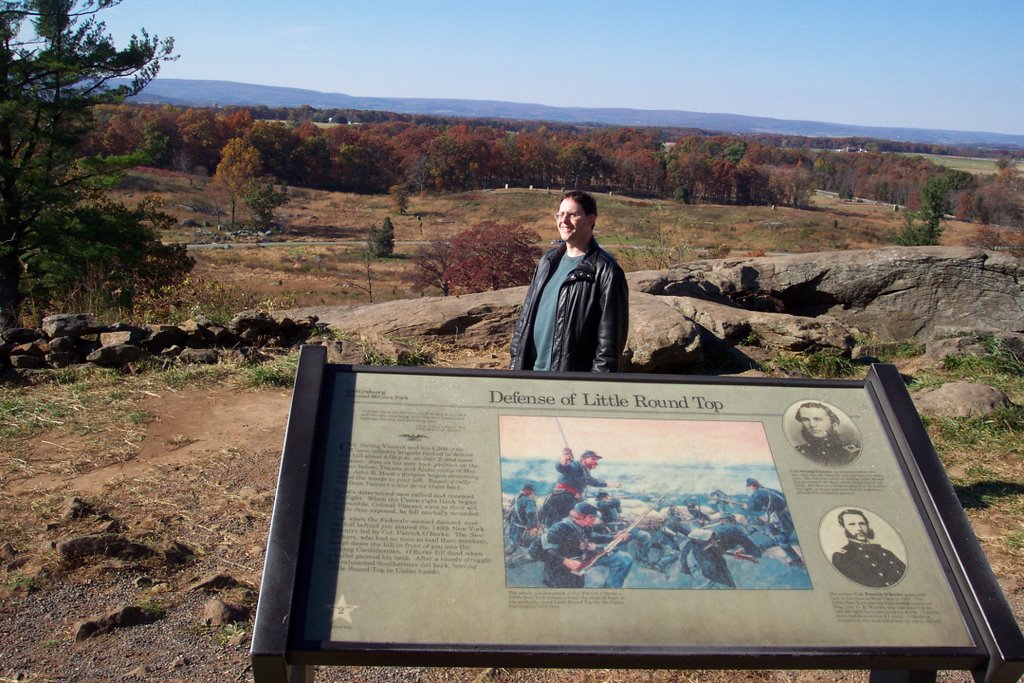
We hit Little Round Top next. This was an important hill which was for all intents and purposes the end of the main Union line. However for some stupid reason it was also practically devoid of Union troops on July 2nd when the Confederates launched an attack on it. Had they captured this hill, the Union forces would have been outflanked and nearly surrounded. But Brigadier General Gouverneur K. Warren, an engineer with the Union Signal Corps, suddenly realized this and frantically worked to get Union soldiers onto the hill as the Confederates came on. The Union troops took to the hilltop just in time, throwing up crude stone wall breastworks and firing back down onto the attackers. The Confederates then dug in below the hill and their sharpshooters began picking off exposed Union troops. Finally the Union managed to push the Confederates off with a bayonet charge down the hill. Both sides skirmished back and forth around this hill for the rest of that day and the next, until finally the Confederates pulled back, losing 1,185 men dead, wounded or missing. The Union lost 565 men. A Confederate victory here would have put the Union line in serious jeopardy and made Pickett's Charge unnecessary the next day.

Here's Aaron telling everyone how he would have fought this battle. On the left can be seen some of the rocks piled up by Union soldiers as a hasty defense against Southern rifle balls.


Gettysburg was the beginning of the end for the Confederacy. It was also a bloody tragedy where 51,000 men were killed or wounded in just three days. A defeated Lee pulled his shattered force back towards Virginia, and had Union General Meade followed up with an attack he might have taken Lee and his entire army and brought the war to a virtual close. But Meade wasn't known for his agressiveness and he let Lee slip away, a fact which caused President Lincoln to eventually remove him from command. And soon both armies were gone, leaving the local townsfolk the task of burying the thousands of dead from both sides. I heard that it took them over five years to find and bury them all. And reading about it is one thing, but it's no substitute for actually seeing the sites and walking the land.


Finally we headed back. We stopped at Harpers Ferry on the way back for ice cream at Swiss Miss (Lagniappe's favorite) and I showed Aaron some of the local sights, including the old firehouse where John Brown and his band of terrorists were holed up after their attack on the United States Arsenal here went bad.

They were eventually captured by an obscure United States Colonel named Robert E. Lee and an equally obscure United States Lieutenant named JEB Stuart. These men went on to greatness when they switched sides a few years later and fought as heroes of the Confederacy. That's right--General Lee of Gettysburg fame was once here at the beginning as a Union Colonel.

I am sorry that we didn't get down to Manassas for a day, but the next time he comes, we'll hit that and Fredericksburg. As it was, we had a good time, got a lot of work done, saw a lot of historic sites, and dranks a fair amount of beer. It's good to have a "guy week" sometimes.


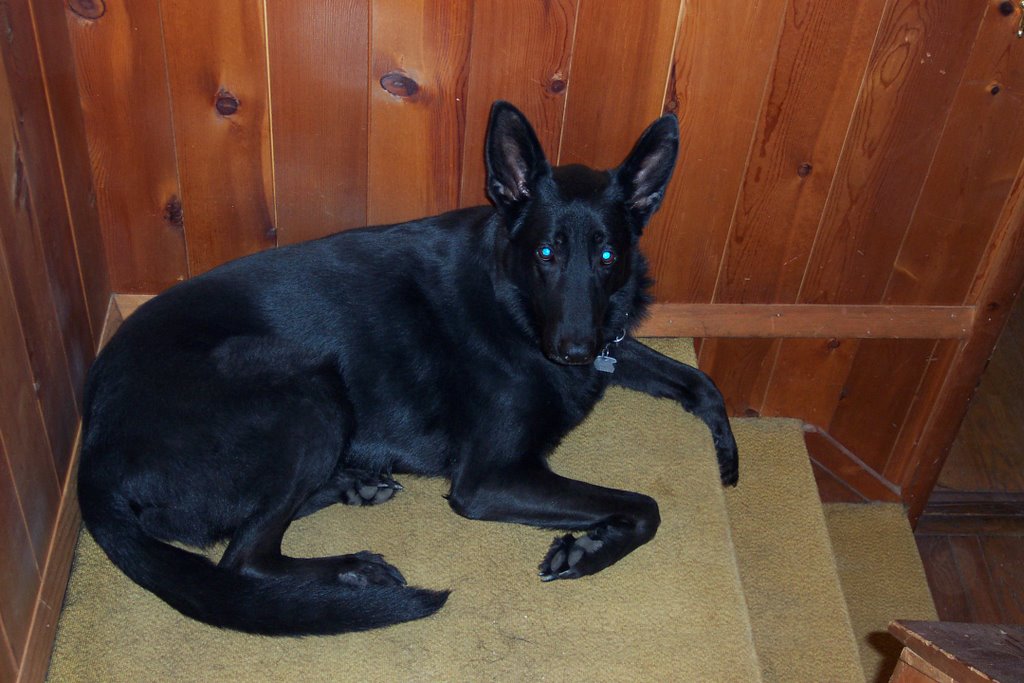
"Is he gone yet?" Lagniappe was a bit jealous of and put out by my company. But he's happy now that Aaron's gone. Silly insecure dog.