Yep. The Pima Air Museum has several Communist MiG fighters in it's collection, reportedly aircraft that were initially acquired covertly by our Air Force to allow our fighter pilots to train against them in aerial combat, then retired to the boneyard and subsequently transferred to this (and other) museums when no longer needed.
They've got two MiG 15s inside their buidings, #822 here, painted up as a North Korean MiG, is down on the floor where you can paw it over.
And there's a slightly newer version, done up in Polish colors, hanging from the ceiling in their main hangar.
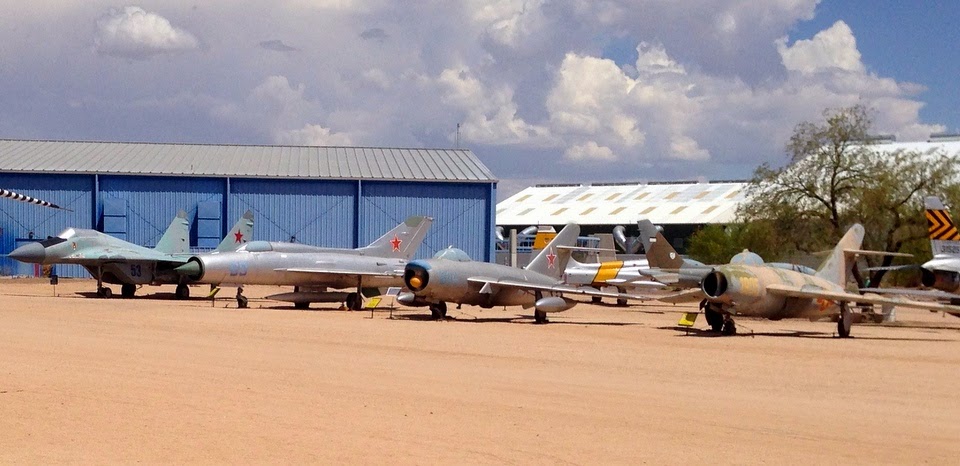
But most of them are still outside, like these MiG-17s, baking in the Arizona sun.
The -17 was an improved version of the -15, with a longer fuselage and more sharpy-swept wings and tail surfaces to improve flight characteristics at high speed.
In Vietnam, these relatively crude aircraft could knock out an American F-4 Phantom by closing to gun range, turning inside the Phantom, and nailing it with it's 37MM and two 23mm cannon mounted in it's nose. (And this was back when your "best and brightest" engineers had decided that our fighters--like the early Phantoms--no longer needed guns because missiles were supposed to do it all at long distance.)

This one is actually marked up as a North Vietnamese fighter.
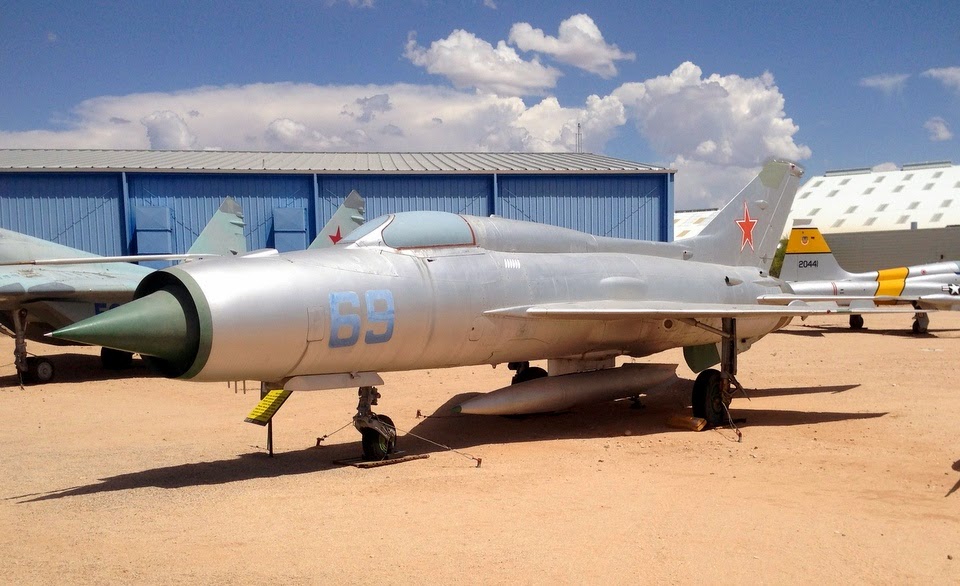
And here's a MiG-21, a real agile performer, described by US pilot-evaluators as "a knife fighter in a phone booth".
These are some of the most heavily-produced Soviet designs and a lot of them are starting to pop up on the civilian market dirt cheap, with 44 of them in private handsa in the US already, per the FAA. Admittedly I've been tempted, but buying the plane and being able to keep it maintained are two different things, especially as these older soviet engines were pretty much designed to be disposable after relatively few hours of operation.
Still...there's no denying that these things can fly, and they do look pretty cunning, eh?
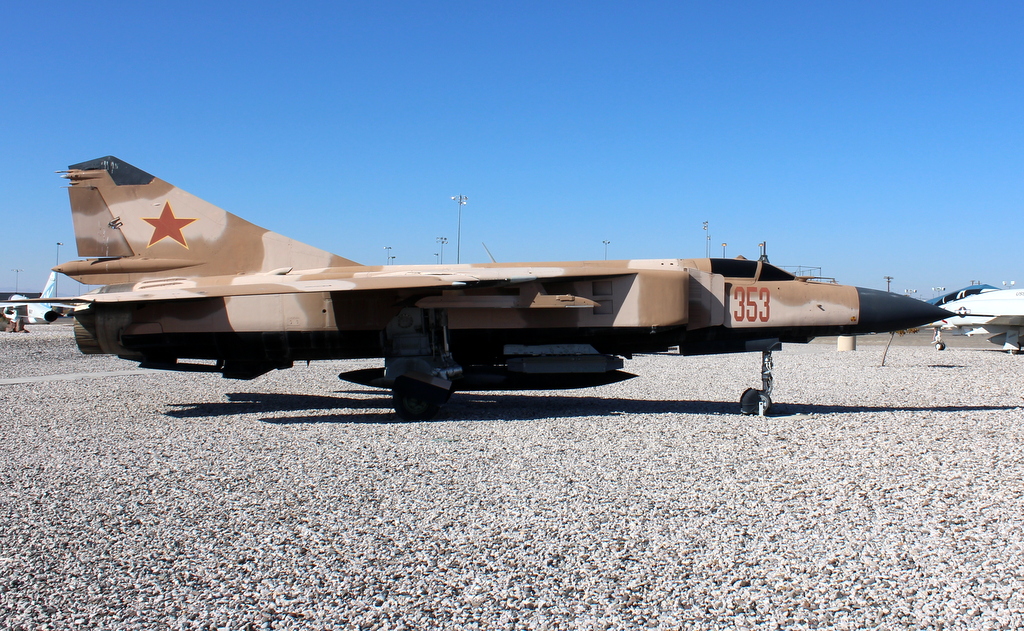
And here below is a Soviet MiG-23, codename: "Flogger".
They were fast interceptors, utilizing variable-geometry, or "swing-wing" technology.
These aircraft were potent when flying fast in a straight line. When vectored in on NATO aircraft by ground controllers, they were capable of making highly effective slashing attacks and disappearing, but if they had to stand and fight, their flight characteristics were less than impressive. The aircraft had speed, but it was unstable, according to American Red Eagle evaluators. In 1984, Three-Star General Robert Bond was killed while flying one, drawing a lot of attention to the activities of the secretive 4477th Test and Evaluation Squadron that was operating MiGs as part of a classified training program for US pilots. It was this crash that finally forced the Air Force to admit that we were in fact acquiring and flying Soviet aircraft.
They's got a MiG-29 "Fulcrum" here, too.
Developed as a counter to the American F-15, the Soviets seemed to have gotten it right with this one. These are still built and exported all over the world today, and they seem to be pretty impressive performers based on what I've read.
They are capable of Mach 2.2 flight, and they're rugged and easier to maintain than earlier Soviet designs. They're supposed to be a match for US fighters, but I have to note that the US Air Force did shoot down several of them over Kosovo in 1998-1999 with no reciprocal losses to that platform.
Now I confess to not being a MiG expert in the slightest, so if I've gotten something wrong or left something noteworthy out, hopefully someone a bit more knowledgeable will come along soon and offer up a comment or two. Meantime, hope you enjoy the pics as much as I enjoyed taking them, even if it was well over a hundred degrees out there.