In 1964's The Killers, Ronald Reagan played Jack Browning, a wealthy criminal planning a big heist. (It was the only time he ever played the part of a villain during his acting career.)
In this role, he had to give an insolent young Angie Dickinson what she had coming when she defied him in front of his men.
Afterwards though, he said that it was easily the most distasteful thing he'd done in Hollywood. He really wasn't that sort of guy, even in pretend-land.
But at least in the movie, he got his in the end, courtesy of mortally-wounded hit-man Lee Marvin. And so did she.
Two other favorites of mine, Norman Fell and Claude Akins, also starred in this movie adaptation of a Hemmingway story.
Showing posts with label Ronald Reagan. Show all posts
Showing posts with label Ronald Reagan. Show all posts
Saturday, August 01, 2015


Wednesday, April 23, 2014
Monday, May 28, 2012
Memorial Day.

On this Memorial Day, I wanted to share some of pictures that I've taken at Arlington National Cemetery. May we never forget.


And now for a few words from a President that every American could be proud of. President Ronald Reagan, Memorial Day, 1984, at Arlington National Cemetery.
Friday, February 11, 2011
Obama called himself WHAT?!
He dared. He actually dared refer to himself as "The Gipper" today while lamenting the departure of his outgoing Chief Propagandist Robert Gibbs.
Time out, Barry. Politically speaking, there is and will always be just one Gipper: Ronald Reagan. You are not the Gipper. You pale in his shadow on your best day. Barry, we've discussed your attempts to channel President Reagan (and other real men) in the past. We've discussed it here and we've discussed it here. You'll never be President Reagan or those other men, Barry. They were patriots before they were partisan. They knew what it was like to labor and sweat and sacrifice. They stood up to our enemies and critics because they had spines. They had pride in this country. They even had birth certificates.
You need to stop comparing yourself to your betters, Barry. You ran as "a different kind of President" and in so doing, you made your own bed. So lie in it and savor your high unfavorable ratings and just let the rest of us remember a time when America was led by real men.
And for those who need a comparison, I offer the following.
The Gipper:
The Gypper:
Who would you rather have addressing the world and dealing with those who would do us harm?
Anyone?
Bueller?
Anyone?
President Obama recounts an anecdote about the 2004 Democratic National Convention at White House Press Secretary Robert Gibbs' final press briefing:
"The most challenging problem was what tie to wear. And this went up to the very last minute. I mean, 10 minutes before we were about to go on stage we were still having an argument about ties. I had bought five, six ties. And Michelle didn't like any of them, Axelrod didn't like a couple of them -- him being one of the best dressed men in the world. So we really valued his opinion.
"And then somebody -- I don't remember who it was -- turned and said, 'You know what? What about Gibbs' tie? What about Gibbs' tie? That might look good.' And, frankly, Robert didn't want to give it up because he thought he looked really good in the tie. But eventually he was willing to take one for the gipper, and so he took off his tie, and I put it on. And that's the tie that I wore at the national convention."
Time out, Barry. Politically speaking, there is and will always be just one Gipper: Ronald Reagan. You are not the Gipper. You pale in his shadow on your best day. Barry, we've discussed your attempts to channel President Reagan (and other real men) in the past. We've discussed it here and we've discussed it here. You'll never be President Reagan or those other men, Barry. They were patriots before they were partisan. They knew what it was like to labor and sweat and sacrifice. They stood up to our enemies and critics because they had spines. They had pride in this country. They even had birth certificates.
You need to stop comparing yourself to your betters, Barry. You ran as "a different kind of President" and in so doing, you made your own bed. So lie in it and savor your high unfavorable ratings and just let the rest of us remember a time when America was led by real men.
And for those who need a comparison, I offer the following.
The Gipper:
The Gypper:
Who would you rather have addressing the world and dealing with those who would do us harm?
Anyone?
Bueller?
Anyone?
Wednesday, February 09, 2011
In Defense of President Reagan
Not that our greatest 20th Century President needs defending, but commenter NE posted a few issues that he has with The Gipper, so I felt like responding here in a new post rather than sully the President's commemorative post.
NE said:
And by way of reply, NE you say that I don't understand your viewpoints. But it's difficult when you refuse to be specific about what exactly President Reagan has done that has made your life harder. You claim that he's supported some awful extra-national organizations in the fight against Communism, but then you don't say which ones. Are you trying to say that Communism wasn't the scourge and threat to the world that those of us who were here and operating in the adult world in the 1980's remember it as being? I note that you haven't told us yet how old you are, and that's you're right, but it would help to know if I'm talking to a generational peer who, like me, was actually there, or just someone who only knows about those days from reading history books and listening to leftist professors talk about them. Fact is, everyone who was of age to understand in the 1980's knew that Communism had to be stopped, and it was, chiefly by President Reagan and the like-minded patriots in his administration along with our military, which he built back up to credible levels after President Carter gutted it. If you can't appreciate a strong military, it's most likely because you can't remember a time when America needed one, and for that you can thank President Reagan.
You next say that you don't like Presidents who speak to us like children. Well if that's the case, you must be beside yourself with Obama in office. He's always belittling someone for not understanding his greatness or his agenda. But President Reagan never did that to anyone. He was known as The Great Communicator precisely because he was able to explain his plans, ideas and concepts for government to the people of this country in such a way that people understood and agreed. He did not talk down to people like Obama does, nor did he ever insult either his critics or this country as Obama does routinely. President Reagan actually engaged people and talked straight to people, and he gave people reasons to be proud of this country and our place in the world. That's why he was so popular: he was a leader, not a term-limited dictator, and he respected the American people enough to regularly address them, unlike Obama, who generally refuses to do press conferences and never takes questions.
And as for cutting education, well in the first place, there's nothing wrong with cutting the federal government out of what should be a state's task exclusively. As a citizen and taxpayer in the State of West Virginia, I should not be given a bill for schools in California, Texas or anywhere outside of my state. This nation is supposed to be made up of 50 largely sovereign states, after all, not one big kingdom run by a room full of jokers in Washington, DC who don't know jack about the needs and issues of any one state. President Reagan understood that. He also understood that the biggest impediment to schools actually teaching was and still is the teachers' unions. To the extent that his policies weakened those, America owes him a debt of gratitude. However, I doubt that his efforts to take control of the schools away from the unions and the DC bureaucrats back in the 1980's can be blamed for the state of schools today. That's just silly.
Finally, on your bit about “Social Justice” in the form of wealth redistribution—taking from those who earned it and doling it out among those who chose not to bother—that is socialism at it's rawest, and it's something that our country's founders sought to prevent here. You name a few other people—without specific cites again—and accuse them of supporting government-sponsored theft, but that, even if true, doesn't make it right. President Reagan knew that when Americans are free to acquire wealth by hard work and innovation, the whole country prospers and the world is a better place. And the only ones who oppose such things are the ones too lazy to go out and work hard enough to make it, and the Democrats who cater to those lazy ones in exchange for their votes. (Frankly, it's the liberal elites and their followers talking about such "social justice" that spurs gun purchases by the rest of us who worked for what we have and intend to keep it. But that's for another post.)
In summation, even with a Democratic Congress trying to undermine him for eight years, Ronald Reagan gave our country a period of great prosperity and made us safer than we've been at any time since the end of World War Two. He beat the Russians, he checked terrorists and the states that sponsored them, and he brought freedom and democracy to several other nations as well, all while championing greater freedom and independence from oppressive government and cutting taxes here at home. he was also an unabashed Christian and a Patriot. That's why he's remembered so fondly today while lesser Presidents like Carter, Clinton and Bush Sr. are but footnotes in the history books.
It's truly a pity that you weren't here to experience President Reagan's terms firsthand, because they were eight great years for this country, and that was despite the best efforts of the Democrats and the mainstream media, who failed to stop him from restoring hope and pride to every American and making the world a better place.

NE said:
Hey, I'm the guy out of my comfort zone reading and commenting on a conservative blog. I don't see much attempt to understand my viewpoints. Other conservative bloggers have have successfully altered my views on gun-control and immigration, so it's not like I'm set in stone. It's better not to use sweeping generalizations that cannot be proven like “most of Reagan's critics are failures” or all liberal policies fail as they tend to discredit your argument.
Perhaps I was being overly dramatic when I said I spent my life trying to undo Reagan's policies. While I do believe he did significant harm to America as president, it is the Reagan myths and simplifications I have worked to eliminate. Reagan presented the world in black and white terms - us good, them bad, deregulation good, government bad. He gave credence to falsehoods like "welfare queens" and short-sightedly supported some truly awful extra-national organizations in a knee-jerk response to communism. That mindset has stuck with us and now we have news channels that just bark talking points at us 24/7. The world is much more complicated and we deserve leaders who speak to American like critical-thinking adults, not children content to clap whenever anyone says a buzzword into a microphone.
So I researched and wrote up a whole big long history of how Reagan systematically worked to dismantle public education in both California (as governor) and the nation as a whole (as president), but it occurred to me that you might not see that as a bad thing. We might need to establish that public education is good thing first. To answer your question, Reagan's education policy is what has affected me the most personally. I see his face in the crumbling walls and moldy textbooks of the schools I volunteer at. I am reminded everyday that Reagan continued to cut the nation's ED budget despite his own commission on education warning against it for reasons of national security. He blamed falling test scores on excessive federal intervention even after several credible studies showed the exact opposite was true. Public education has never recovered, and now we find ourselves struggling to compete globally in a field we dominated for most of the 20th century. If you want to know more on Reagan's education policies I could finish it up and post the whole sad story, or you could pick out another issue and I'll do my best to back up my views on it.
Also,
Social justice is a movement for equity. It is a term used to describe the efforts of many in moving wealth and power from those that have a lot of it to those that have very little. If that concept flashes an image of Karl Marx in your head, it shouldn't, because the basic philosophy is rooted in the teachings of Thomas Aquinas, a Catholic saint. Social justice has furthered by everyone from Andrew Jackson to MLK Jr.
And by way of reply, NE you say that I don't understand your viewpoints. But it's difficult when you refuse to be specific about what exactly President Reagan has done that has made your life harder. You claim that he's supported some awful extra-national organizations in the fight against Communism, but then you don't say which ones. Are you trying to say that Communism wasn't the scourge and threat to the world that those of us who were here and operating in the adult world in the 1980's remember it as being? I note that you haven't told us yet how old you are, and that's you're right, but it would help to know if I'm talking to a generational peer who, like me, was actually there, or just someone who only knows about those days from reading history books and listening to leftist professors talk about them. Fact is, everyone who was of age to understand in the 1980's knew that Communism had to be stopped, and it was, chiefly by President Reagan and the like-minded patriots in his administration along with our military, which he built back up to credible levels after President Carter gutted it. If you can't appreciate a strong military, it's most likely because you can't remember a time when America needed one, and for that you can thank President Reagan.
You next say that you don't like Presidents who speak to us like children. Well if that's the case, you must be beside yourself with Obama in office. He's always belittling someone for not understanding his greatness or his agenda. But President Reagan never did that to anyone. He was known as The Great Communicator precisely because he was able to explain his plans, ideas and concepts for government to the people of this country in such a way that people understood and agreed. He did not talk down to people like Obama does, nor did he ever insult either his critics or this country as Obama does routinely. President Reagan actually engaged people and talked straight to people, and he gave people reasons to be proud of this country and our place in the world. That's why he was so popular: he was a leader, not a term-limited dictator, and he respected the American people enough to regularly address them, unlike Obama, who generally refuses to do press conferences and never takes questions.
And as for cutting education, well in the first place, there's nothing wrong with cutting the federal government out of what should be a state's task exclusively. As a citizen and taxpayer in the State of West Virginia, I should not be given a bill for schools in California, Texas or anywhere outside of my state. This nation is supposed to be made up of 50 largely sovereign states, after all, not one big kingdom run by a room full of jokers in Washington, DC who don't know jack about the needs and issues of any one state. President Reagan understood that. He also understood that the biggest impediment to schools actually teaching was and still is the teachers' unions. To the extent that his policies weakened those, America owes him a debt of gratitude. However, I doubt that his efforts to take control of the schools away from the unions and the DC bureaucrats back in the 1980's can be blamed for the state of schools today. That's just silly.
Finally, on your bit about “Social Justice” in the form of wealth redistribution—taking from those who earned it and doling it out among those who chose not to bother—that is socialism at it's rawest, and it's something that our country's founders sought to prevent here. You name a few other people—without specific cites again—and accuse them of supporting government-sponsored theft, but that, even if true, doesn't make it right. President Reagan knew that when Americans are free to acquire wealth by hard work and innovation, the whole country prospers and the world is a better place. And the only ones who oppose such things are the ones too lazy to go out and work hard enough to make it, and the Democrats who cater to those lazy ones in exchange for their votes. (Frankly, it's the liberal elites and their followers talking about such "social justice" that spurs gun purchases by the rest of us who worked for what we have and intend to keep it. But that's for another post.)
In summation, even with a Democratic Congress trying to undermine him for eight years, Ronald Reagan gave our country a period of great prosperity and made us safer than we've been at any time since the end of World War Two. He beat the Russians, he checked terrorists and the states that sponsored them, and he brought freedom and democracy to several other nations as well, all while championing greater freedom and independence from oppressive government and cutting taxes here at home. he was also an unabashed Christian and a Patriot. That's why he's remembered so fondly today while lesser Presidents like Carter, Clinton and Bush Sr. are but footnotes in the history books.
It's truly a pity that you weren't here to experience President Reagan's terms firsthand, because they were eight great years for this country, and that was despite the best efforts of the Democrats and the mainstream media, who failed to stop him from restoring hope and pride to every American and making the world a better place.

Saturday, February 05, 2011
Happy 100th Birthday, Mr. President
On February 6th, 1911, Ronald Wilson Reagan was born. He was an accomplished actor, starring in over 50 films. He was president of the Screen Actors Guild back when Hollywood was filled with patriotic stars who loved America as much as America loved them. (Boy, that's sure changed, hasn't it?) He was a two-term governor of California back when that state was still worth living in. (That's changed, too.)
And he came along when America needed a real leader after four long, dark, depressing years of Jimmy Carter. And he was just what America needed. Grounded in solid conservative principles, he was a strong leader, both domestically and in world affairs. Though the Democrats tried to hobble him for eight years, and the media relentlessly tried to bring him down, he not only survived, but he prospered and he beat them at their own game. He stood up to unions and to the Communists (OK, that's redundant, I know.) He fought terrorists and sowed the seeds of freedom in a number of countries, from Grenada and Nicaragua to a newly reunified Germany. He brought an end to the Cold War, and he made people feel proud to be Americans. He was also adored overseas by people who wanted to be free. Ronald Reagan was an icon who, in my opinion, belongs on Mt. Rushmore right alongside of the other great presidents carved there for all time.
He was a real man, as I've previously pointed out here and here. But he was genuinely warm and charismatic, and he never seemed to care what his hateful liberal critics said about him behind his back. He knew he was right and he went on to make America great in spite of them.
He could be funny.
He could handle hecklers like few other politicians would ever dare:
He could handle Sam Donaldson:
He understood the role of government and advocated liberty and freedom for our citizens.
And he could be forceful in support of freedom of others.
Here he was in his pre-political days, on the old show "What's My Line?"
And here he was at a 1977 roast for Frank Sinatra.
President Reagan was a leader, a uniter, and a role model for a nation, if not the world. He was never bitter or petty, and he was always proud of this great country and it's citizens. Ronald Reagan never had an unkind word for anyone, and he never forgot his place as America's highest public servant. In his eight years as President, he reportedly never ever took his suit jacket off while in the Oval Office, out of respect for the office. Later, lesser men who followed him (the current occupant of that office in particular) could do well to learn from the examples that he set, both as a President and as a man. Ronald Wilson Reagan made America great again, and every great American will always remember him with pride.
And he came along when America needed a real leader after four long, dark, depressing years of Jimmy Carter. And he was just what America needed. Grounded in solid conservative principles, he was a strong leader, both domestically and in world affairs. Though the Democrats tried to hobble him for eight years, and the media relentlessly tried to bring him down, he not only survived, but he prospered and he beat them at their own game. He stood up to unions and to the Communists (OK, that's redundant, I know.) He fought terrorists and sowed the seeds of freedom in a number of countries, from Grenada and Nicaragua to a newly reunified Germany. He brought an end to the Cold War, and he made people feel proud to be Americans. He was also adored overseas by people who wanted to be free. Ronald Reagan was an icon who, in my opinion, belongs on Mt. Rushmore right alongside of the other great presidents carved there for all time.
He was a real man, as I've previously pointed out here and here. But he was genuinely warm and charismatic, and he never seemed to care what his hateful liberal critics said about him behind his back. He knew he was right and he went on to make America great in spite of them.
He could be funny.
He could handle hecklers like few other politicians would ever dare:
He could handle Sam Donaldson:
He understood the role of government and advocated liberty and freedom for our citizens.
And he could be forceful in support of freedom of others.
Here he was in his pre-political days, on the old show "What's My Line?"
And here he was at a 1977 roast for Frank Sinatra.
President Reagan was a leader, a uniter, and a role model for a nation, if not the world. He was never bitter or petty, and he was always proud of this great country and it's citizens. Ronald Reagan never had an unkind word for anyone, and he never forgot his place as America's highest public servant. In his eight years as President, he reportedly never ever took his suit jacket off while in the Oval Office, out of respect for the office. Later, lesser men who followed him (the current occupant of that office in particular) could do well to learn from the examples that he set, both as a President and as a man. Ronald Wilson Reagan made America great again, and every great American will always remember him with pride.
Saturday Man Movie
Today's Saturday Man Movie revolves around several real men, the likes of which are unknown in Hollywood today. In The Killers, produced in 1964 and adopted from a short story written by Ernest Hemmingway, we see Jack Browning, played by Ronald Reagan--a real man on and off the screen--teaching Angie Dickinson's Sheila Farr to do what she's told.
Obviously that didn't set well with Johnny North, played by John Cassavette (another real man), who, after belting the future best President ever in the mouth, steals away with Dickinson, trying to save her from Browning.
OK, maybe Johnny North should have thought that one through a little better. That Sheila was pure evil and not at all ready to walk away from her meal ticket Jack.
But the movie ends in a way that we could expect from Hemmingway--when confronted by hired killer Charlie Strom, played by Lee Marvin (yet another real man), Sheila throws Jack under the bus too in order to save herself.
So much for that. And lest you think that Johnny North got away clean, his death at the hands of Strom a year ago was the opening scene to this excellent movie.
This suspense-filled masterpiece was Ronald Reagan's last movie before he went into politics, and it was the only one in which he played a villain. For years afterwards, he always expressed regret over that role because he hadn't liked slapping a woman, particularly Angie Dickinson, who was a good friend of his.
Lee Marvin, on the other hand, said that it was one of the movies that he enjoyed the most.
Claude Akins and Norman Fell had roles in this one, too. Definitely worth seeing even after I untwisted most of the plot for you, if only for the star power. This one was vintage Hollywood--not a girly-man like Woody Harrelson or Brad Pitt even allowed near the set.
Obviously that didn't set well with Johnny North, played by John Cassavette (another real man), who, after belting the future best President ever in the mouth, steals away with Dickinson, trying to save her from Browning.
OK, maybe Johnny North should have thought that one through a little better. That Sheila was pure evil and not at all ready to walk away from her meal ticket Jack.
But the movie ends in a way that we could expect from Hemmingway--when confronted by hired killer Charlie Strom, played by Lee Marvin (yet another real man), Sheila throws Jack under the bus too in order to save herself.
So much for that. And lest you think that Johnny North got away clean, his death at the hands of Strom a year ago was the opening scene to this excellent movie.
This suspense-filled masterpiece was Ronald Reagan's last movie before he went into politics, and it was the only one in which he played a villain. For years afterwards, he always expressed regret over that role because he hadn't liked slapping a woman, particularly Angie Dickinson, who was a good friend of his.
Lee Marvin, on the other hand, said that it was one of the movies that he enjoyed the most.
Claude Akins and Norman Fell had roles in this one, too. Definitely worth seeing even after I untwisted most of the plot for you, if only for the star power. This one was vintage Hollywood--not a girly-man like Woody Harrelson or Brad Pitt even allowed near the set.
Wednesday, September 01, 2010
Then and Now...


Back then, we had a man's man as our leader, and the world knew it and respected us for it. The bad people feared us and the good people wanted to be like us.
But now? Now we've got Steve Urkel, wearing his wife's jeans and riding his daughter's bicycle.
 And the world just sneers and laughs as the clown music plays.
Saturday, November 28, 2009
America...where'd your spine go?
There was a time when Americans could justifiably take pride in their Presidents, because America has had, at times, some serious bad-ass Presidents who stood tall, spoke their mind and meant what they said. These were men who made the world spin just a little differently on it's axis, and no one wanted to mess with us when they were in the White House.
 President Andrew Jackson was such a man. He began his career as a militia officer who excelled at solving "Indian problems" in the American South. Basically, when Indians got out of line and killed settlers, Jackson went down and whipped their asses until the survivors had enough and promised to behave or move west. Then he led a volunteer band from Tennessee and Kentucky down to New Orleans, assembled a pick-up crew that included farmers, shopkeepers, riverboatmen, naval sailors whose ships were sunk, freed blacks, and even pirates, and he cleaned the clocks of a professional British invasion force at Chalmette, Louisiana, killing over 2,000 of them for a loss of about 12-14 Americans.
When not killing Indians or the British, Jackson fought duels with pistols, suffering two serious gunshot wounds himself as a result of these fights but also killing one his opponents in return. He was also the subject of the first assassination attempt against a US President with a crazy house painter by the name of Richard Lawrence ran up and tried to shoot him with two pistols, both of which misfired. Jackson then proceeded to beat Lawrence near to death with his hickory cane before others intervened. How do you not admire a man like that? Even his inauguration was such a rowdy affair when his former soldiers and other frontier supporters showed up at the White House that the White House was nearly destroyed after the free booze caused things to get out of hand. Old Hickory was a President that no one here or abroad ever wanted to mess with.
 A bit later, we had Theodore Roosevelt. He was an accomplished big-game hunter, a boxer, and a military man who, among other things, assembled a volunteer cavalry unit made up of cowboys and the upper-crust of Yale and Harvard's sports teams, and led them to Cuba where they kicked Spanish butt all the way up San Juan Hill and back down the other side. "Speak softly but carry a big stick," he said. And America did just that. He brought a lot of Central America under control and got the Panama Canal built. He was a man's man and no one wanted to mess with him. Like Jackson before him, he was the subject of an assassination attempt while campaigning in 1912. A man named John Schrank shot him on the chest, but Roosevelt decided that he was not in any danger of dying from the wound since he wasn't coughing up blood, so he went on to deliver his campaign speech, speaking for 90 minutes while bleeding.
Following World War Two, America elected it's former Supreme Commander in Europe, Five-Star General Dwight D. Eisenhower, to the Presidency. Again, this man knew how to take care of business. Graduating West Point in 1911, he rose to the General Staff by the time that the US entered the Second World War and his decisions helped bring it to a successful conclusion. He went on to become the first Supreme Commander of NATO, and as President, he was responsible for the development of both our nuclear weapons program and our rise to the challenges of the Space race. He gave is the interstate highway system that we all know and use today (Originally intended to help move military traffic across the country quickly) and he implemented the Eisenhower Doctrine, under which the US would be prepared to respond with force against any aggression committed by a communist country. And the world understood that he wasn't playing.
 And then there was President Ronald Reagan. He started out playing tough guys in the movies, and he ended up a real tough guy on the world stage, serving two terms as President. His credentials, like those before him, were not questioned by America's enemies. The Iranians had been punking America's prior president, Jimmy Carter, by holding our embassy staff hostage for 444 days. But they released them on the day that Reagan took office, because they knew that Reagan, unlike Carter, was a man who would have rolled up his sleeves and settled that Iranian problem with military muscle.
The eight years of the Reagan Presidency were bad years for communists and assorted bad guys everywhere.

He suppressed a communist-launched coup in Grenada, he called on Russia to tear down the Berlin Wall (and they did), he authorized US combat aircraft to intercept terrorists who had hijacked the cruise ship Achille Lauro and murdered US citizen Leon Klinghoffer, and he sent other combat aircraft to bomb targets in Libya in retaliation for Libyan President Khadaffi's support of other terrorist acts in Europe and the Middle East. Reagan's policies brought the Cold War with Russia to a stunning end as the Soviet economy collapsed, and he also brought about the fall of the Nicaraguan Communist government despite the best efforts of the Communists and the Democrats in Congress to stop him. Because of President Reagan, millions of people around the world knew freedom by the end of 1988.
America lost her way for a bit, as demonstrated by the election of Bill Clinton. Under Clinton, terrorists and dictators like Iraq's Saddam Hussein felt free to constantly kick our country in the nuts abroad and even here at home. The World Trade Center was bombed in 1993, and when nothing was done about it by the Clinton Administration, Osama bin Laden came back for another whack at it on September 11, 2001.
 But he erred grievously, because America had just elected another President who was cut from better cloth. George W. Bush, a former military fighter pilot, took decisive action like a real man would. Afghanistan's terrorist-supporting Taliban was hit hard and Saddam Hussein was removed from power, brought to trial, and executed by the new democratically-elected government of Iraq.
I may not have cared for much of what President Bush did domestically during his time in office, but as Commander-in-Chief, he rocked.
So what do we have in office now, during a time when real leadership is required and our military is fighting two wars? Do we have a Jackson, a Roosevelt, an Eisenhower, a Reagan or even a Bush to make the tough decisions and support our troops? Do we have a man with a backbone, a firm jaw, and the first-hand understanding of what it means to fight?
No, we don't. We just have Obi Wan Ke-dopey:


God help us.
 President Andrew Jackson was such a man. He began his career as a militia officer who excelled at solving "Indian problems" in the American South. Basically, when Indians got out of line and killed settlers, Jackson went down and whipped their asses until the survivors had enough and promised to behave or move west. Then he led a volunteer band from Tennessee and Kentucky down to New Orleans, assembled a pick-up crew that included farmers, shopkeepers, riverboatmen, naval sailors whose ships were sunk, freed blacks, and even pirates, and he cleaned the clocks of a professional British invasion force at Chalmette, Louisiana, killing over 2,000 of them for a loss of about 12-14 Americans.
When not killing Indians or the British, Jackson fought duels with pistols, suffering two serious gunshot wounds himself as a result of these fights but also killing one his opponents in return. He was also the subject of the first assassination attempt against a US President with a crazy house painter by the name of Richard Lawrence ran up and tried to shoot him with two pistols, both of which misfired. Jackson then proceeded to beat Lawrence near to death with his hickory cane before others intervened. How do you not admire a man like that? Even his inauguration was such a rowdy affair when his former soldiers and other frontier supporters showed up at the White House that the White House was nearly destroyed after the free booze caused things to get out of hand. Old Hickory was a President that no one here or abroad ever wanted to mess with.
 A bit later, we had Theodore Roosevelt. He was an accomplished big-game hunter, a boxer, and a military man who, among other things, assembled a volunteer cavalry unit made up of cowboys and the upper-crust of Yale and Harvard's sports teams, and led them to Cuba where they kicked Spanish butt all the way up San Juan Hill and back down the other side. "Speak softly but carry a big stick," he said. And America did just that. He brought a lot of Central America under control and got the Panama Canal built. He was a man's man and no one wanted to mess with him. Like Jackson before him, he was the subject of an assassination attempt while campaigning in 1912. A man named John Schrank shot him on the chest, but Roosevelt decided that he was not in any danger of dying from the wound since he wasn't coughing up blood, so he went on to deliver his campaign speech, speaking for 90 minutes while bleeding.
Following World War Two, America elected it's former Supreme Commander in Europe, Five-Star General Dwight D. Eisenhower, to the Presidency.
 Again, this man knew how to take care of business. Graduating West Point in 1911, he rose to the General Staff by the time that the US entered the Second World War and his decisions helped bring it to a successful conclusion. He went on to become the first Supreme Commander of NATO, and as President, he was responsible for the development of both our nuclear weapons program and our rise to the challenges of the Space race. He gave is the interstate highway system that we all know and use today (Originally intended to help move military traffic across the country quickly) and he implemented the Eisenhower Doctrine, under which the US would be prepared to respond with force against any aggression committed by a communist country. And the world understood that he wasn't playing.
 And then there was President Ronald Reagan. He started out playing tough guys in the movies, and he ended up a real tough guy on the world stage, serving two terms as President. His credentials, like those before him, were not questioned by America's enemies. The Iranians had been punking America's prior president, Jimmy Carter, by holding our embassy staff hostage for 444 days. But they released them on the day that Reagan took office, because they knew that Reagan, unlike Carter, was a man who would have rolled up his sleeves and settled that Iranian problem with military muscle.
 The eight years of the Reagan Presidency were bad years for communists and assorted bad guys everywhere.

He suppressed a communist-launched coup in Grenada, he called on Russia to tear down the Berlin Wall (and they did), he authorized US combat aircraft to intercept terrorists who had hijacked the cruise ship Achille Lauro and murdered US citizen Leon Klinghoffer, and he sent other combat aircraft to bomb targets in Libya in retaliation for Libyan President Khadaffi's support of other terrorist acts in Europe and the Middle East. Reagan's policies brought the Cold War with Russia to a stunning end as the Soviet economy collapsed, and he also brought about the fall of the Nicaraguan Communist government despite the best efforts of the Communists and the Democrats in Congress to stop him. Because of President Reagan, millions of people around the world knew freedom by the end of 1988.
America lost her way for a bit, as demonstrated by the election of Bill Clinton. Under Clinton, terrorists and dictators like Iraq's Saddam Hussein felt free to constantly kick our country in the nuts abroad and even here at home. The World Trade Center was bombed in 1993, and when nothing was done about it by the Clinton Administration, Osama bin Laden came back for another whack at it on September 11, 2001.
 But he erred grievously, because America had just elected another President who was cut from better cloth. George W. Bush, a former military fighter pilot, took decisive action like a real man would. Afghanistan's terrorist-supporting Taliban was hit hard and Saddam Hussein was removed from power, brought to trial, and executed by the new democratically-elected government of Iraq.
I may not have cared for much of what President Bush did domestically during his time in office, but as Commander-in-Chief, he rocked.
So what do we have in office now, during a time when real leadership is required and our military is fighting two wars? Do we have a Jackson, a Roosevelt, an Eisenhower, a Reagan or even a Bush to make the tough decisions and support our troops? Do we have a man with a backbone, a firm jaw, and the first-hand understanding of what it means to fight?
No, we don't. We just have Obi Wan Ke-dopey:


God help us.
Wednesday, June 24, 2009
Sarah Palin vs. Jennifer Granholm
OK, this is the match-up that people in the media keep talking about. Apparently the Dems are upset because Alaska's Governor Palin is considered hot and more than a little sexy by much of America. So they're now trying to market Canadian-born Michigan Governor Jennifer Granholm as an alternative.
Playboy even has a poll on it (Granholm's getting stomped) and many talking heads and snarky leftist columnists are comparing the two. Most of them, predictably, are trying to make the claim that Granholm is allegedly smarter than Governor Palin because she went to Berkeley and because Obama's considering her for a US Supreme Court slot. Of course they overlook the fact that her meteoric rise to the governorship of Michigan came about through political patronage and little else, unlike Sarah Palin's. Yes, Jenny Granholm started out as Corporation Counsel for corruption-plagued Wayne County, Michigan (think "Detroit", folks), where she was basically a lackey for Ed McNamara, the man who also made Kwame Kilpatrick Detroit's mayor before he went to jail.
Jenny rode McNamara's coattails and used his influence to become Michigan's first female Attorney general, a position in which she basically did nothing other than pose for photos and hold press conferences while dramatically shrinking that office's staff of criminal prosecutors. Using that publicity and running against a former governor that no one wanted to see back in office (Jim Blanchard, folks...Michigan's version of Jimmy Carter), She replaced outgoing conservative Governor John Engler, inheriting from him a robust state economy and bulging state coffers. (Engler had saved Michigan from Blanchard's ruinous policies just as President Reagan had saved America from Carter's. Conservatism works wherever it's allowed to be implemented, folks.)
Jenny managed to narrowly win the governorship, a feat credited in large part to Kwame Kilpatrick turning out the Detroit voters--almost all of whom vote Democrat--in record numbers. It was just enough to push her over the top even though most of the state's rural population voted against her, proving once again that "Machine" politics is effective, and usually to the detriment of everyone but the machine.
But here's the part that most people who like to compare Granholm to Governor Palin overlook:
Under Governor Palin's leadership, Alaska's economy soared, and the people in that state enjoy somme of the lowest taxes and least amount of government regulation in the country. Through Palin's negotiations with the oil companies, the average Alaskan gets over a thousand dollars a year in Permanent Fund (royalty) payments in lieu of paying a state income tax. People in Alaska are keeping their money and actually getting paid directly as the rightful beneficiaries of favorable contracts negotiated on their behalf by their governor (Palin) and other elected officials. Alaska's unemployment rate is below the national average (9.4%) at 8.0%. Michigan's--one of the lowest in the country when Governor Engler was running things just a few years ago--is now one of America's highest at 14.1%. Good job, Jenny! Just keep taxing those businesses like you've done since taking office. The revenues are just flowing in from that scheme, aren't they?
So to those who want to compare the two woman governors, it's time to put the snark aside and focus on actual records. While it may by fun and serve a political agenda to mock Governor Palin and pretend that she's some sort of hick or buffoon, all while holding Governor Granholm out as the next star child, honesty requires an evaluation of their respective accomplishments, and that evaluation is more devastating to Granholm's image than anything that Tina Fey or David Letterman could ever say. You see, the facts paint a different picture. They show us two governors, one of whom--Jenny Granholm--was handed the throne in a state that was looked upon as a model for the nation, only to tank it in her first term, all while the other governor--Sarah Palin--clawed her way to the top on her own merits by promising the voters a government based in conservative principles. Governor Palin kept those promises and her state is one of the healthiest today, in stark contrast to the formerly healthy one that Granholm rode into the ground. And it begs the question: all other things being equal, where would you rather live and who would you rather have in charge if you had a choice? People are moving to Alaska today to take advantage of the jobs and the opportunities there. I haven't heard of anyone deliberately moving to Michigan--or even staying if they could get out--for a long time.
Take a bow, Governors Palin and Granholm. Your accomplishments and your legacies speak much louder than the political hacks and the late-night talk-show fools. And when you compare those accomplishments and legacies, suddenly Governor Palin doesn't look all that dumb, nor does Governor Granholm look all that bright.
Playboy even has a poll on it (Granholm's getting stomped) and many talking heads and snarky leftist columnists are comparing the two. Most of them, predictably, are trying to make the claim that Granholm is allegedly smarter than Governor Palin because she went to Berkeley and because Obama's considering her for a US Supreme Court slot. Of course they overlook the fact that her meteoric rise to the governorship of Michigan came about through political patronage and little else, unlike Sarah Palin's. Yes, Jenny Granholm started out as Corporation Counsel for corruption-plagued Wayne County, Michigan (think "Detroit", folks), where she was basically a lackey for Ed McNamara, the man who also made Kwame Kilpatrick Detroit's mayor before he went to jail.
Jenny rode McNamara's coattails and used his influence to become Michigan's first female Attorney general, a position in which she basically did nothing other than pose for photos and hold press conferences while dramatically shrinking that office's staff of criminal prosecutors. Using that publicity and running against a former governor that no one wanted to see back in office (Jim Blanchard, folks...Michigan's version of Jimmy Carter), She replaced outgoing conservative Governor John Engler, inheriting from him a robust state economy and bulging state coffers. (Engler had saved Michigan from Blanchard's ruinous policies just as President Reagan had saved America from Carter's. Conservatism works wherever it's allowed to be implemented, folks.)
Jenny managed to narrowly win the governorship, a feat credited in large part to Kwame Kilpatrick turning out the Detroit voters--almost all of whom vote Democrat--in record numbers. It was just enough to push her over the top even though most of the state's rural population voted against her, proving once again that "Machine" politics is effective, and usually to the detriment of everyone but the machine.
But here's the part that most people who like to compare Granholm to Governor Palin overlook:
Under Governor Palin's leadership, Alaska's economy soared, and the people in that state enjoy somme of the lowest taxes and least amount of government regulation in the country. Through Palin's negotiations with the oil companies, the average Alaskan gets over a thousand dollars a year in Permanent Fund (royalty) payments in lieu of paying a state income tax. People in Alaska are keeping their money and actually getting paid directly as the rightful beneficiaries of favorable contracts negotiated on their behalf by their governor (Palin) and other elected officials. Alaska's unemployment rate is below the national average (9.4%) at 8.0%. Michigan's--one of the lowest in the country when Governor Engler was running things just a few years ago--is now one of America's highest at 14.1%. Good job, Jenny! Just keep taxing those businesses like you've done since taking office. The revenues are just flowing in from that scheme, aren't they?
So to those who want to compare the two woman governors, it's time to put the snark aside and focus on actual records. While it may by fun and serve a political agenda to mock Governor Palin and pretend that she's some sort of hick or buffoon, all while holding Governor Granholm out as the next star child, honesty requires an evaluation of their respective accomplishments, and that evaluation is more devastating to Granholm's image than anything that Tina Fey or David Letterman could ever say. You see, the facts paint a different picture. They show us two governors, one of whom--Jenny Granholm--was handed the throne in a state that was looked upon as a model for the nation, only to tank it in her first term, all while the other governor--Sarah Palin--clawed her way to the top on her own merits by promising the voters a government based in conservative principles. Governor Palin kept those promises and her state is one of the healthiest today, in stark contrast to the formerly healthy one that Granholm rode into the ground. And it begs the question: all other things being equal, where would you rather live and who would you rather have in charge if you had a choice? People are moving to Alaska today to take advantage of the jobs and the opportunities there. I haven't heard of anyone deliberately moving to Michigan--or even staying if they could get out--for a long time.
Take a bow, Governors Palin and Granholm. Your accomplishments and your legacies speak much louder than the political hacks and the late-night talk-show fools. And when you compare those accomplishments and legacies, suddenly Governor Palin doesn't look all that dumb, nor does Governor Granholm look all that bright.
Saturday, April 11, 2009
On Presidents and pirates and the resolve to uphold our national honor
So here we are, not even three months into the four years of the Obama Presidency, and we have our first new military crisis. A band of four--yes, four--pirates attacked an American-flagged ship and kidnapped it's American citizen captain, and the world is watching to see what Obama plans to do about it.
Unfortunately, other than dithering behind the scenes while publicly refusing to address it, Obama doesn't appear to be doing anything at all. Our SEAL teams--professionals who exist specifically to handle this sort of thing--are sitting idle.
And the world shakes it's collective head.
There was a proud time--actually there were many proud times over the years--when the American flag stood for a sovereignty that was inviolate. Bad guys of every stripe and color knew that if you messed with Old Glory, you would shortly have your ass handed to you. Over the years, we've taught many nations the folly of attacking the United States or It's possessions. We taught the British (twice), we taught the Spanish and the Mexicans more than once, and in the last century we taught the Japanese and the Germans, the Libyans, the Russians, and most recently, Saddam Hussein and the Taliban along with several terrorist outfits. The world knows that America can, has and will kick your ass if you get stupid and harm our people.
Unfortunately the world also knows that every now and again, WE get stupid and elect leaders who lack the spine to kick ass. And then all of the evildoers rush to hit us and get their licks in and get clear before we replace those leaders with new ones that have balls and they set things to rights again.
Look back through our history. Ronald Reagan defined "American Pride" in the 20th Century. When PLO terrorists hijacked the Italian cruise ship Achille Lauro and killed a wheelchair-bound American named Leon Klinghoffer, the Europeans on scene sniveled and quaked and finally granted the terrorists safe passage away from their crime. But President Reagan sent the US Navy to intercept their jet, and that's exactly what they did.
"You can run, but you can't hide." President Reagan told the world's thugs.
When Libyan leader Ghadaffi insisted on supporting terrorist operations against US and other personnel overseas and our European "allies" refused to act, President Reagan unilaterally acted by sending the US Air Force to Libya and giving Ghadaffi a serious attitude adjustment that stopped his support for terrorists cold. American President Ronald Wilson Reagan was a man that you did not mess with, and the creeps of the world figured that out and quit messing with the US of A.
Of course you can't put Reagan into perspective without looking at the man who preceded him. President Jimmy Carter had been an appeaser and a vacillator to the extent that even a bunch of Iranian students (backed up by the Iranian government) attacked our embassy in Tehran and held American citizens captive for 444 days, knowing full well that Carter did not have the guts to do anything about it. Sure enough, after one horribly mismanaged rescue attempt went wrong, Carter basically retreated into a corner and sucked his thumb for the rest of his term. But the Iranians weren't stupid; as soon as they saw President-elect Reagan rolling up his sleeves, they released the hostages on the eve of his inauguration. They knew what his first act would have been had they not, and it likely would have involved large numbers of US marines and soldiers and lots of trashed Iranian real estate.
Things went well for Americans under President Reagan and his successor, President George H. Bush. The bad guys knew that Bush--Reagan's former Vice-President--would maintain the Reagan Doctrine as far as it pertained to ferreting out those who murdered Americans and killing them and often anyone with them. But then came President Clinton, and he was too busy sticking cigars into Monica Lewinsky's private places to deal with such pesky trivialities like the 1993 bombing of the World Trade Center and other terrorist attacks, all of which he dismissed as "law enforcement problems" and allowed to go unresponded to. Incredibly, when the government of the Sudan offered to hand the Clinton Administration Osama bin Laden free of charge, he declined. The result: September 11, 2001, and the largest terrorist attack on American soil in the history of our country.
Well it sucked to be an enemy of America after that. President George W. Bush responded strongly and decisively and the Taliban in Afghanistan and got their asses kicked almost simultaneously with Saddam Hussein and his followers in Iraq. The citizens in both of those countries are free now, thanks to US President Bush. The panty-wearers and bedwetters of the American liberal establishment have always hated President Bush, but not one of them could ever say that America and Americans abroad weren't safer with him at the helm then they were under Clinton.
And lest anyone think that this is a Republican vs. Democrats issue, it's not. Many have thought so over the years, and the Russians in particular erred badly when they tried to punk newbie Democrat President John F. Kennedy both in Europe and in Cuba. (Missile Crisis, anyone?) Kennedy didn't actually have to kick the Russians' asses, but that was only because they realized that he was fixin' to and backed down. Kennedy had balls, and more people than Marilyn Monroe came to know it.
Also, let me remind you that the first US president to project American military power overseas (ironically, in pursuit of pirates) was Thomas Jefferson, a Democrat. When the rest of the world was paying tribute and/or ransom to the Barbary Pirates, Jefferson sent the new US Navy and Marines over to kick their Barbary asses. Result: no more piracy, and the world was a safer place for all--even our lily-livered European "allies".
President Andrew Jackson was a Democrat too. He never had to send the Marines anywhere. He was so bad-ass that everyone in the world knew that if they disrespected us with Jackson in office, he'd personally go kick their asses.
Sadly, the Democrats celebrate both of these men as icons today, but without regard for the fact that Jefferson and Jackson represented a time when even Democrat males had testosterone. That's not the case any more though, and our latest Democratic president, Barack "don't call me B.O." Obama proves it. While four terrorists in an out-of-gas lifeboat thumb their noses at us, he just sits there. Apparently this is one of those times when even his trusty teleprompter can't help him look slicker and more decisive than he really is.
If any of the other Presidents that I've mentioned here--Reagan, Kennedy, Jefferson, Jackson, either Bush--was in charge now (or even someone like Theodore Roosevelt), is there any doubt that we'd have our citizen back and there'd be four less pirates in the world right now? That was the sort of dynamic leadership that we've had at critical times in our country's history and it's the kind of dynamic leadership that we need now because it would deter any more of this sort of nonsense. God help us, President Obama is not that kind of leader, and like Clinton and Carter before him, I predict that he's only going to open the door to much, much more of this sort of thing if he keeps insisting on merely talking to our enemies and refusing to demand that they straighten up and fly right. and our enemies know that they're not dealing with Reagan or Bush any more--they're dealing with a guy who takes his cues from Jimmy Carter and Neville Chamberlain. The SEALs won't be sent because Obama is reportedly too afraid of offending the Somalis. In other words, the bad guys have gotten the message and that message is: "Game on and go like hell until America wises up and elects a real President again."
2010 and President Palin can't get here quick enough for me.
Additional: Oliver North on Reagan.
Unfortunately, other than dithering behind the scenes while publicly refusing to address it, Obama doesn't appear to be doing anything at all. Our SEAL teams--professionals who exist specifically to handle this sort of thing--are sitting idle.
And the world shakes it's collective head.
There was a proud time--actually there were many proud times over the years--when the American flag stood for a sovereignty that was inviolate. Bad guys of every stripe and color knew that if you messed with Old Glory, you would shortly have your ass handed to you. Over the years, we've taught many nations the folly of attacking the United States or It's possessions. We taught the British (twice), we taught the Spanish and the Mexicans more than once, and in the last century we taught the Japanese and the Germans, the Libyans, the Russians, and most recently, Saddam Hussein and the Taliban along with several terrorist outfits. The world knows that America can, has and will kick your ass if you get stupid and harm our people.
Unfortunately the world also knows that every now and again, WE get stupid and elect leaders who lack the spine to kick ass. And then all of the evildoers rush to hit us and get their licks in and get clear before we replace those leaders with new ones that have balls and they set things to rights again.
Look back through our history. Ronald Reagan defined "American Pride" in the 20th Century. When PLO terrorists hijacked the Italian cruise ship Achille Lauro and killed a wheelchair-bound American named Leon Klinghoffer, the Europeans on scene sniveled and quaked and finally granted the terrorists safe passage away from their crime. But President Reagan sent the US Navy to intercept their jet, and that's exactly what they did.
"You can run, but you can't hide." President Reagan told the world's thugs.
When Libyan leader Ghadaffi insisted on supporting terrorist operations against US and other personnel overseas and our European "allies" refused to act, President Reagan unilaterally acted by sending the US Air Force to Libya and giving Ghadaffi a serious attitude adjustment that stopped his support for terrorists cold. American President Ronald Wilson Reagan was a man that you did not mess with, and the creeps of the world figured that out and quit messing with the US of A.
Of course you can't put Reagan into perspective without looking at the man who preceded him. President Jimmy Carter had been an appeaser and a vacillator to the extent that even a bunch of Iranian students (backed up by the Iranian government) attacked our embassy in Tehran and held American citizens captive for 444 days, knowing full well that Carter did not have the guts to do anything about it. Sure enough, after one horribly mismanaged rescue attempt went wrong, Carter basically retreated into a corner and sucked his thumb for the rest of his term. But the Iranians weren't stupid; as soon as they saw President-elect Reagan rolling up his sleeves, they released the hostages on the eve of his inauguration. They knew what his first act would have been had they not, and it likely would have involved large numbers of US marines and soldiers and lots of trashed Iranian real estate.
Things went well for Americans under President Reagan and his successor, President George H. Bush. The bad guys knew that Bush--Reagan's former Vice-President--would maintain the Reagan Doctrine as far as it pertained to ferreting out those who murdered Americans and killing them and often anyone with them. But then came President Clinton, and he was too busy sticking cigars into Monica Lewinsky's private places to deal with such pesky trivialities like the 1993 bombing of the World Trade Center and other terrorist attacks, all of which he dismissed as "law enforcement problems" and allowed to go unresponded to. Incredibly, when the government of the Sudan offered to hand the Clinton Administration Osama bin Laden free of charge, he declined. The result: September 11, 2001, and the largest terrorist attack on American soil in the history of our country.
Well it sucked to be an enemy of America after that. President George W. Bush responded strongly and decisively and the Taliban in Afghanistan and got their asses kicked almost simultaneously with Saddam Hussein and his followers in Iraq. The citizens in both of those countries are free now, thanks to US President Bush. The panty-wearers and bedwetters of the American liberal establishment have always hated President Bush, but not one of them could ever say that America and Americans abroad weren't safer with him at the helm then they were under Clinton.
And lest anyone think that this is a Republican vs. Democrats issue, it's not. Many have thought so over the years, and the Russians in particular erred badly when they tried to punk newbie Democrat President John F. Kennedy both in Europe and in Cuba. (Missile Crisis, anyone?) Kennedy didn't actually have to kick the Russians' asses, but that was only because they realized that he was fixin' to and backed down. Kennedy had balls, and more people than Marilyn Monroe came to know it.
Also, let me remind you that the first US president to project American military power overseas (ironically, in pursuit of pirates) was Thomas Jefferson, a Democrat. When the rest of the world was paying tribute and/or ransom to the Barbary Pirates, Jefferson sent the new US Navy and Marines over to kick their Barbary asses. Result: no more piracy, and the world was a safer place for all--even our lily-livered European "allies".
President Andrew Jackson was a Democrat too. He never had to send the Marines anywhere. He was so bad-ass that everyone in the world knew that if they disrespected us with Jackson in office, he'd personally go kick their asses.
Sadly, the Democrats celebrate both of these men as icons today, but without regard for the fact that Jefferson and Jackson represented a time when even Democrat males had testosterone. That's not the case any more though, and our latest Democratic president, Barack "don't call me B.O." Obama proves it. While four terrorists in an out-of-gas lifeboat thumb their noses at us, he just sits there. Apparently this is one of those times when even his trusty teleprompter can't help him look slicker and more decisive than he really is.
If any of the other Presidents that I've mentioned here--Reagan, Kennedy, Jefferson, Jackson, either Bush--was in charge now (or even someone like Theodore Roosevelt), is there any doubt that we'd have our citizen back and there'd be four less pirates in the world right now? That was the sort of dynamic leadership that we've had at critical times in our country's history and it's the kind of dynamic leadership that we need now because it would deter any more of this sort of nonsense. God help us, President Obama is not that kind of leader, and like Clinton and Carter before him, I predict that he's only going to open the door to much, much more of this sort of thing if he keeps insisting on merely talking to our enemies and refusing to demand that they straighten up and fly right. and our enemies know that they're not dealing with Reagan or Bush any more--they're dealing with a guy who takes his cues from Jimmy Carter and Neville Chamberlain. The SEALs won't be sent because Obama is reportedly too afraid of offending the Somalis. In other words, the bad guys have gotten the message and that message is: "Game on and go like hell until America wises up and elects a real President again."
2010 and President Palin can't get here quick enough for me.

Additional: Oliver North on Reagan.
Saturday, September 15, 2007
Saturday Morning--Cowboys and left-handedness!
It's Saturday, and that means that Lagniappe and I watched cowboy movies on AMC until noon, same as we do every Saturday.
OK, I watched cowboy movies. He beat up his stuffed Care-Bear.
This morning's movie was "Law and Order" a 1953 classic starring our greatest 20th Century President Ronald Reagan as Frame Johnson, an ex-marshal who just wants to settle down but who is plagued by a town's evil land baron until he does what the good guy always does in post-World War Two westerns--stand tall where others cower and single-handedly combat the villains with punches and bullets until they're all vanquished.
And as I watched Reagan in action on the screen, I suddenly noticed something that basically only a left-handed gun guy would notice: his pistol holster was on his left hip. Ronald Reagan was left-handed!
So after the movie was over, I did some checking, and sure enough, our 40th President was a southpaw. (And so were James Garfield, Herbert Hoover, Harry Truman, Gerald Ford, George Bush Senior, and (ugh!) Bill Clinton.)
Other famous left-handers are/were:
Founding Fathers Thomas Jefferson, Sam Adams and Benjamin Franklin, Lt. Col. Oliver North, Astronauts Edwin "Buzz" Aldrin and Wally Schirra, Generals H. NormDan Schwartzkopf and Nathaniel Bedford Forrest, Attorney Clarence Darrow, Cartoonist Bill Maudlin, British Prime Minister Winston Churchill, and bad guys John Dillinger and John Wesley Hardin. Authors Mark Twain and H.G. Wells were left-handed, and so was guitarist Jimi Hendrix. Some of my favorite actors were left-handed as well, including Don Adams, Dan Aykroyd, George Kennedy, Chuck Connors, Charlie Chaplin, W.C. Fields, Eddie Albert, Keith Carradine, Harry Anderson, Robert DeNiro, Dick Van Dyke, Steve McQueen, Telly Savalas and Don Rickles.
So if you're left-handed, welcome to the club. It's one with many prestigious members!
OK, I watched cowboy movies. He beat up his stuffed Care-Bear.
This morning's movie was "Law and Order" a 1953 classic starring our greatest 20th Century President Ronald Reagan as Frame Johnson, an ex-marshal who just wants to settle down but who is plagued by a town's evil land baron until he does what the good guy always does in post-World War Two westerns--stand tall where others cower and single-handedly combat the villains with punches and bullets until they're all vanquished.
And as I watched Reagan in action on the screen, I suddenly noticed something that basically only a left-handed gun guy would notice: his pistol holster was on his left hip. Ronald Reagan was left-handed!
So after the movie was over, I did some checking, and sure enough, our 40th President was a southpaw. (And so were James Garfield, Herbert Hoover, Harry Truman, Gerald Ford, George Bush Senior, and (ugh!) Bill Clinton.)
Other famous left-handers are/were:
Founding Fathers Thomas Jefferson, Sam Adams and Benjamin Franklin, Lt. Col. Oliver North, Astronauts Edwin "Buzz" Aldrin and Wally Schirra, Generals H. NormDan Schwartzkopf and Nathaniel Bedford Forrest, Attorney Clarence Darrow, Cartoonist Bill Maudlin, British Prime Minister Winston Churchill, and bad guys John Dillinger and John Wesley Hardin. Authors Mark Twain and H.G. Wells were left-handed, and so was guitarist Jimi Hendrix. Some of my favorite actors were left-handed as well, including Don Adams, Dan Aykroyd, George Kennedy, Chuck Connors, Charlie Chaplin, W.C. Fields, Eddie Albert, Keith Carradine, Harry Anderson, Robert DeNiro, Dick Van Dyke, Steve McQueen, Telly Savalas and Don Rickles.
So if you're left-handed, welcome to the club. It's one with many prestigious members!
Saturday, December 24, 2005
The Library
Other than an armory that dwarfs those of many police departments (and a few third-world nations), I have a pretty good library. I don't care for television that much and really only have one because it was a gift, but I love to read. This is the library.

There's a pretty good selection of books here. Mostly it's American history. There's quite a few on the American Revolution and the War of 1812 (You know--the one where we had to whomp on the British and remind them again that we weren't just a bunch of upstart colonies.) There's a growing Civil War (War of Northern Aggression) section. This period now fascinates me more since I've moved into an area where much of the fighting took place. Post-war industrialism and western expansion is the next big section. It covers the rise of the railroads, mining, and western frontier life. Both World Wars are covered, as are Korea and Vietnam.

Other military periods are represented as well, including the Age of Piracy, The United States naval war against the Mediterranean pirates (The shores of Tripoli...), the Boer War, the Russian Revolution,and United States interventions in Central America. There's also a couple on the French involvements in Algeria and Vietnam. (Predictably they got their asses handed to them. But hey--it's what the French are best at--losing.)
I've also got many regional books covering some of my favorite parts of the country. There are good sections on Michigan, Louisiana, Alaska, and West Virginia. I've spent time in all these places and learned to love them.
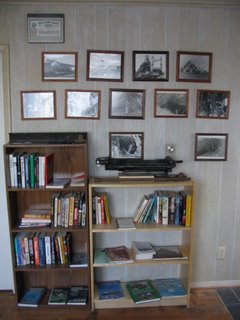
The regional books sit on these shelves underneath a couple of my favorite mining artifacts.
The large drill there is a Rand compressed air drill which I discovered in an abandoned silver mine in Colorado. It took me the better part of a day to move that 60 lb drill from the tunnel I found it in out through several hundred yards of water-filled passages and then down the side of a mountain so steep that it would have frustrated a mountain goat. Finally I had to carry it over a mile back to my camper. I was tired and sore, and if I hadn't wanted one of these so badly I'd have chucked it away a dozen times. But I got it.
And the long metal bar atop the other case is a piece of iron narrow-gauge railroad track that I took from one of the underground passages of a northern Michigan copper mine. This is what the mine haulage cars used to travel over back in the 1800's before this mine closed for goos around the turn of the century. Again, I had to climb a 70-degree shaft with this for more than 500 feet to reach the air vent that I'd slithered into the mine through and then I had to carry it a mile and a half back to my truck. But the good things are worth working for.
There's a good political section in my library as well, including a number of books written by one of my favorite past Presidents, Richard M. Nixon. Nixon is one of my favorites because of all of the things he managed to accomplish. He opened the trade door to China and established decent relations with Russia. He established the Environmental Protection Agency, ended the draft and got us out of Vietnam. He also appointed Warren Burger and William Rehnquist to the Supreme Court and thus helped make America safe from the encroachments of Liberalism. Nixon was also a foreign policy expert of the first order and his memoirs and foreign policy texts show amazing insight and perception. It's my goal to eventually obtain all of his books and I'm sorry that he's no longer with us.
Other favorite Presidents of mine are Theodore Roosevelt and Ronald Reagan.
Roosevelt is a favorite for his conservation work, his success in checking the big trusts and breaking the old-boys' network in Congress, and his military exploits in Cubaa as well as his foreign policy doctrines that established America as a regional if not a world power for the first time. And of course we wouldn't have had the Panama Canal without T.R.
Reagan was another great man who came along at the right time. He won the Cold War, freed the people of Nicaragua and eliminated the threat of a Communist air base there, beat the unions into shape when the Air Traffic Controllers struck, and rejuvenated our economy. And he did all of this with a hostile Congress that was willing to see America take a beating on the world stage if only they could bring about President Reagan's defeat or embarrass him somehow. I loved this man as a President and I had the honor of working at his funeral procession. I'd have done it for free out of respect for that man and his legacy.
Usually I spend my evenings reading the books in my nice soft chair in front of this fireplace. I also have a nice selection of classics and they're my favorite for light evening reading. These are the books next to the fireplace.

I have many works here by Mark Twain, John Steinbeck, Sir Arthur Conan Doyle, Jack London, Ernest Hemmingway, Charles Dickens, Herman Melville, Robert Louis Stevenson, H. Rider Haggard, James Fenimore Cooper, Jules Verne, H.G. Wells, Ayn Rand and many other fine authors. Lagniappe usually lays next to my chair and dozes or watches the fire. Sometimes I'll snack on roasted peanuts or popcorn and then Lagniappe is an incurable beggar who acts as if he'll die unless I give him some. No wonder he's getting fat.
I have over 900 books presently and as you can see from the new shelves I still have room for more. I'm working on filling the empty shelves now but it becomes a vicious cycle. Space on book shelves means that I need more books. And when I get more books I run out of space on the shelves. So then I get more shelves and now I have more space....
As to the heat sources in Lagniappe's Lair, I have basic electric baseboard heat but I prefer not to use it due to the cost involved.
So I use this neat pellet stove in conjunction with the fireplace.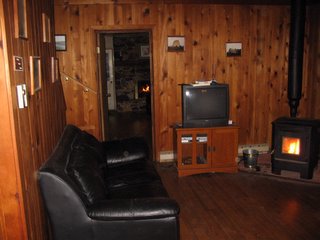
The pellet stove keeps the house toasty warm and I got a ton of pellets for a little over $200.00 and they'll keep me warm all winter.
Also visible there is the accursed television set. Like I said--it was a gift. I do watch it but mainly I just watch videos and old movies since there isn't a single TV show made today that warrants my time or attention.
I do enjoy most anything featuring John Wayne, Clint Eastwood, Chuck Norris or Humphrey Bogart. What can I say--it's a man's world, baby. But I do support equal opportunity and as soon as some cable company comes out with a 24-hour centerfold model mud-wrestling channel, I'll be all over that.
I do own a few movies which I watch over and over again. My favorites are: Billy Jack, The Blues Brothers, Farewell to the King, Full Metal Jacket, and Jesus Christ, Superstar.

There's a pretty good selection of books here. Mostly it's American history. There's quite a few on the American Revolution and the War of 1812 (You know--the one where we had to whomp on the British and remind them again that we weren't just a bunch of upstart colonies.) There's a growing Civil War (War of Northern Aggression) section. This period now fascinates me more since I've moved into an area where much of the fighting took place. Post-war industrialism and western expansion is the next big section. It covers the rise of the railroads, mining, and western frontier life. Both World Wars are covered, as are Korea and Vietnam.

Other military periods are represented as well, including the Age of Piracy, The United States naval war against the Mediterranean pirates (The shores of Tripoli...), the Boer War, the Russian Revolution,and United States interventions in Central America. There's also a couple on the French involvements in Algeria and Vietnam. (Predictably they got their asses handed to them. But hey--it's what the French are best at--losing.)
I've also got many regional books covering some of my favorite parts of the country. There are good sections on Michigan, Louisiana, Alaska, and West Virginia. I've spent time in all these places and learned to love them.
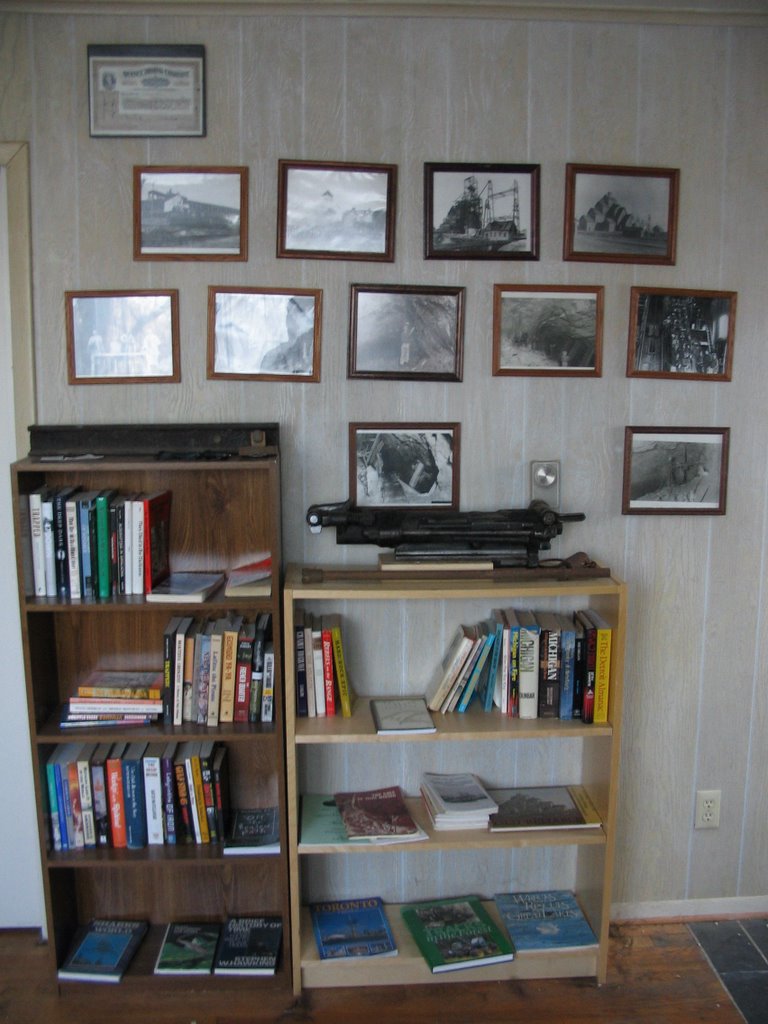
The regional books sit on these shelves underneath a couple of my favorite mining artifacts.
The large drill there is a Rand compressed air drill which I discovered in an abandoned silver mine in Colorado. It took me the better part of a day to move that 60 lb drill from the tunnel I found it in out through several hundred yards of water-filled passages and then down the side of a mountain so steep that it would have frustrated a mountain goat. Finally I had to carry it over a mile back to my camper. I was tired and sore, and if I hadn't wanted one of these so badly I'd have chucked it away a dozen times. But I got it.
And the long metal bar atop the other case is a piece of iron narrow-gauge railroad track that I took from one of the underground passages of a northern Michigan copper mine. This is what the mine haulage cars used to travel over back in the 1800's before this mine closed for goos around the turn of the century. Again, I had to climb a 70-degree shaft with this for more than 500 feet to reach the air vent that I'd slithered into the mine through and then I had to carry it a mile and a half back to my truck. But the good things are worth working for.
There's a good political section in my library as well, including a number of books written by one of my favorite past Presidents, Richard M. Nixon. Nixon is one of my favorites because of all of the things he managed to accomplish. He opened the trade door to China and established decent relations with Russia. He established the Environmental Protection Agency, ended the draft and got us out of Vietnam. He also appointed Warren Burger and William Rehnquist to the Supreme Court and thus helped make America safe from the encroachments of Liberalism. Nixon was also a foreign policy expert of the first order and his memoirs and foreign policy texts show amazing insight and perception. It's my goal to eventually obtain all of his books and I'm sorry that he's no longer with us.
Other favorite Presidents of mine are Theodore Roosevelt and Ronald Reagan.
Roosevelt is a favorite for his conservation work, his success in checking the big trusts and breaking the old-boys' network in Congress, and his military exploits in Cubaa as well as his foreign policy doctrines that established America as a regional if not a world power for the first time. And of course we wouldn't have had the Panama Canal without T.R.
Reagan was another great man who came along at the right time. He won the Cold War, freed the people of Nicaragua and eliminated the threat of a Communist air base there, beat the unions into shape when the Air Traffic Controllers struck, and rejuvenated our economy. And he did all of this with a hostile Congress that was willing to see America take a beating on the world stage if only they could bring about President Reagan's defeat or embarrass him somehow. I loved this man as a President and I had the honor of working at his funeral procession. I'd have done it for free out of respect for that man and his legacy.
Usually I spend my evenings reading the books in my nice soft chair in front of this fireplace. I also have a nice selection of classics and they're my favorite for light evening reading. These are the books next to the fireplace.

I have many works here by Mark Twain, John Steinbeck, Sir Arthur Conan Doyle, Jack London, Ernest Hemmingway, Charles Dickens, Herman Melville, Robert Louis Stevenson, H. Rider Haggard, James Fenimore Cooper, Jules Verne, H.G. Wells, Ayn Rand and many other fine authors. Lagniappe usually lays next to my chair and dozes or watches the fire. Sometimes I'll snack on roasted peanuts or popcorn and then Lagniappe is an incurable beggar who acts as if he'll die unless I give him some. No wonder he's getting fat.
I have over 900 books presently and as you can see from the new shelves I still have room for more. I'm working on filling the empty shelves now but it becomes a vicious cycle. Space on book shelves means that I need more books. And when I get more books I run out of space on the shelves. So then I get more shelves and now I have more space....
As to the heat sources in Lagniappe's Lair, I have basic electric baseboard heat but I prefer not to use it due to the cost involved.
So I use this neat pellet stove in conjunction with the fireplace.

The pellet stove keeps the house toasty warm and I got a ton of pellets for a little over $200.00 and they'll keep me warm all winter.
Also visible there is the accursed television set. Like I said--it was a gift. I do watch it but mainly I just watch videos and old movies since there isn't a single TV show made today that warrants my time or attention.
I do enjoy most anything featuring John Wayne, Clint Eastwood, Chuck Norris or Humphrey Bogart. What can I say--it's a man's world, baby. But I do support equal opportunity and as soon as some cable company comes out with a 24-hour centerfold model mud-wrestling channel, I'll be all over that.
I do own a few movies which I watch over and over again. My favorites are: Billy Jack, The Blues Brothers, Farewell to the King, Full Metal Jacket, and Jesus Christ, Superstar.
Subscribe to:
Posts (Atom)