Showing posts with label Mauser. Show all posts

Thursday, March 26, 2015

An oldie but a goodie. Repaired Turk Mauser ready for the range.

Just because there's more to life than machine guns and "gee whiz" suppressed rifles. Smetimes you just want to relax and enjoy a classic.

Here we have the Model of 1903 Mauser that was initially purchased from Mauser, Oberndorf, Germany for Turkey.

About 200,000 Mauser rifles in assorted calibers were acquired by Turkey from various sources between 1903 and 1905, and many, like this one apparently was, were originally chambered for Mauser's then-new 7.65x53 cartridge. It's basically an 1893/95 style Mauser with a few minor changes. These rifles were subsequently converted to 8mm when the Turks finally got smart and standardized all of their various Mausers to one common caliber, and that's why you see the notch cut out of the receiver ring ahead of the bolt. The old 7.65m action was a bit shorter so the cut had to be made to allow the new 8mm round to clear.

Markings here are: T.C., ASFA, Ankara,. "T.C" means "Turkiye Cumhuriyeti", or "Republic of Turkey". "ASFA" and "Ankara" are for "Askari Fabrika Military Factory", which is in the city of Ankara. The 1939 date would have been when it was rebuilt last in Ankara.

Like most Mausers of the era, the rifle is long but graceful and very well-made. The machining and fitting that went into these old rifles, especially the German-produced ones, was such that the rifles would be cost-prohibitive to manufacture today.

This one has a bolt-disassembly tool built into it's stock.


Unlike the Model 1893's more complex ladder rear sight, the Model 1895 and variants thereof have sliding rears, typically calibrated to allow shots out to 2000 meters. (They were pretty optimistic in those days.)


The straight bolt was still the norm though, as opposed to the nearly-universal curved or "turn-down" bolts that we see today on almost every bolt-action rifle made.

Me personally, I like the straight bolts. as a leftie, they are easier for me to grab and operate as I reach across the rifle.


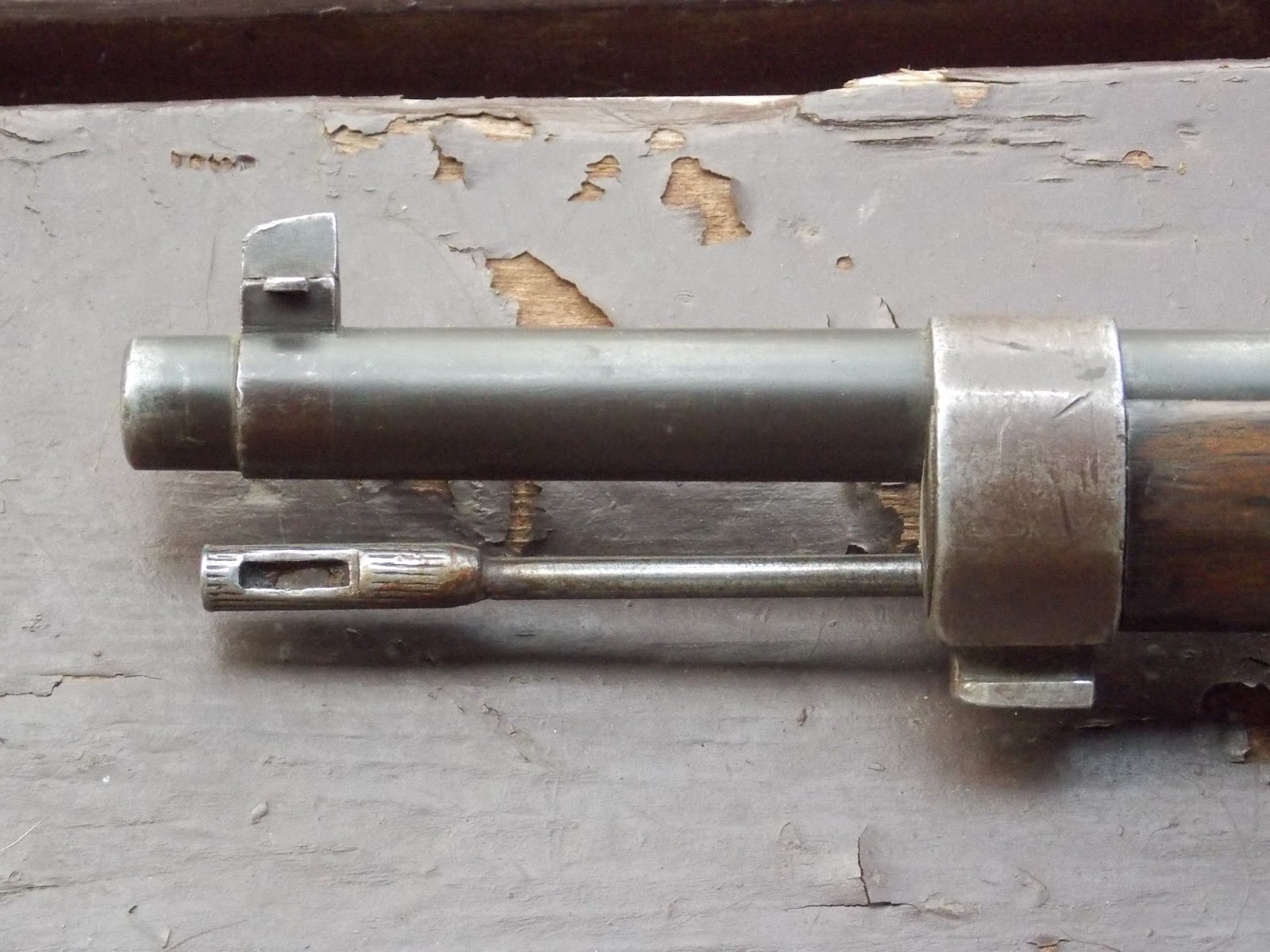
And again, a bayonet lug is visible below the cleaning rod that this rifle still sports.

Now this one was an impulse buy a couple of years ago, and I got it cheap, but it wasn't until I got it home and took it out to the range that I realized that the ejector was broken. The rifle would chamber and shoot cartridges just fine, but then each fired cartridge would just ride the bold back and forth, held fast to the bolt face by the extractor because the ejector that was supposed to flip it off to my right was snapped off.

You know, these old rifles are great, right up until you need spare parts for them. I mean, it's not like I can just call up Mauserwerke and order a new ejector for this century-old relic out of a catalog.

I tried the usual sources for surpus gun parts, Gun Parts Corp. and Sarco, but with no luck, which surprised me, since these guns, though out of production for a long, long time, were never exactly scarce.

I set the gun aside and made it a "project of convenience" and dithered with it every now and again when I was bored. Every now and again, I'd find an ejector somewhere that I thought might work, only to find out after installing it that I was wrong.

I'm actually building up quite a nice collection of old Mauser ejectors.

Part of the problem was that there is also a spring beneath the ejector on these older Mausers, and it took me a while to figure that out and notice that it was also missing from this rifle.

Finally, I found complete ejector box assemblies over at Springfield Sporters and I nabbed one for about $24.00. It arrived today and I quickly installed it.

Ejector box is this rectangular box on the left side of the action. (The part with the screw.) It holds the ejector and ejector spring.

It fit great and it ejects cartridges like a champ. Now all that's left is a range trip so I can sight it in and decide once and for all if it's going to be a keeper or not.


And yes, I bought a spare ejector for an additional five dollars too, because if it broke once...

Turkish Model 1903 specs:

Caliber: 8x57mm Mauser
Overall Length: 49.0 in.
Barrel length: 29.1 in.
Weight: 9.2 lbs
Magazine: Five-round, charger-loaded box
Sights: Inverted V-blade front; rear siding leaf adjustable from 100 to 2,000 meters.

Monday, March 16, 2015

Long overdue range day

Got out to the range today for some long overdue practice.

I took a pair of pistols--a Smith and Wesson Model 57 in .41 Magnum, and a Ruger LCP in .380.
Yeah, a bit of a size difference. And the cartridges are a bit different as well:
The LCP was shooting factory .380 rounds consisting of 95gr. bullets traveling at about 960fps. The .41 rounds were a bit heavier at 215 grains, and they were running about 1250fps per my chronygraph. They grouped well and hit just a couple of inches below point of aim from 20 yards, but I'm still experimenting and I'd like to get the velocity up just a bit more and raise the point of impact a bit to boot.

Bruce, a newer shooter, came out with me to work with his M&P Shield. He's definitely getting better with practice as he becomes more comfortable with it.

He also had this nifty CMP Service Grade Special M-1:
Nice gun. It's one of the ones that the CMP built on a refinished receiver with a new barrel, in this case, a Springfield Armory WW2 serial number and an SA 3/65 barrel.
It has new wood on it that's been causing problems because it is binding on the operating rod and causing the rifle to short-stroke and fail to pick up subsequent rounds from the magazine. I already sanded the rod channel once, but apparently I didn't quite sand enough, and I missed another spot on the left where the rod is still rubbing the wood.
I'm hearing from other CMP shooters that this isn't uncommon, and while I'm glad to see Boyds Gunstocks making these for the CMP, I do wish that they'd make them right. But now Bruce knows where to sand, and hopefully the next time out the rifle will be functioning as flawlessly as a new M1 should.

Meanwhile, Bruce, a brand new shooter, is already putting every round on target at 100 yards.


I had my Spanish 1895 Mauser (cal. 7mm) out to pay with when not spotting for Bruce.
Nothing special here--just a long rifle made at the Ovideo arsenal in 1931.
It wasn't expensive and it looks and shoots nice, so I have no complaints.
At the end of the session, all rounds fired were accounted for on the target. Grouping cound have been a bit better, but I blame myself today, not the rifle.
And as we all know, any day at the range beats any day at work any time.


And back in Alaska:

It's currently Dallas Seavey back in the lead, with Aaron Burmiester in second place just three minutes behind him and Aliy Zirle third. All three have reached Koyuk, as has Jessie Royer, who holds fourth.
Mitch Seavey is in fifth, Martin Buser is back in 20th, the Berington twins are 32nd (Anna) and 33rd (Kristy), Alan Moore is in 47th place and presently in the Kaltag checkpoint--shocking for the guy who just barely took second place in last month's Yukon Quest--and Lisbet Norris has dropped was back to 62nd.

Every musher has dropped at least one dog by now and three mushers are down to 9 dogs each: Nathan Schroeder in 15th, Katherine Kieth in 40th, and Marcelle Fressineau in 57s, still at the Nulato checkpoint. Gotta have 8 dogs to finish.

The four leaders are less than 200 miles from Nome, so we're likely to see a finish sometime tomorrow night or early Wednesday.

Update: As of 2199hrs EST, Dallas Seavey is the first musher out of the Koyuk checkpoint. He rested there for 4hrs, 14 minutes and dropped one dog, leaving him 11 to finish.

Tuesday, September 23, 2014

Don't even start on how YOUR day sucks.

I got to start mine out with a trip to the dentist due to a sudden and severe tooth pain caused by an old filling that decided to crack. So not only did I get that exercise in mouth pain this morning, but then I had to have it fixed by a dentist who introduced herself as "Doctor Smith". Of course I chuckled a bit, and she repied "Yes, I know...it's pretty generic." I told her that I wasn't laughing about that, I was thinking about Dr. Smith from the old TV show Lost in Space. She gets this puzzled look and says that she's never heard of it. The hygienist also shrugs and denies knowledge of the show.

"Really?" I exclaim, suddenly feeling very old. "You two need to leave and send the adult team in here."

The hygienist tries for a save and volunteers that she "sort of" remembers Mork and Mindy. "That was back then too, right?" The dentist says "Oh yeah. Robin Williams was in that, wasn't he?"

Groan.

And to add insult to injury, my insurance doesn't cover repairs like this any more, so the replacement of two fillings was all out of pocket. Glad that I didn't fly this week-end.

I did at least get to the range, however.

This time out, it was the Belgian M1950 Mauser in .30 (.30-06).
I grabbed this old rife and a bag of dubious-looking old reloads on the way out the door. It's been a while since this one's been shot.
ABL = Armee Belge/Belgisch Leger, or "Belgian Army Rifle". This rifle was made in 1952, and the big B is for King Baudouin who was Boss of Belgium in that year. And this one's not blued or parkerized--it's painted gray.
It's interesting to note that Fabrique Nationale was stil making--and the Belgians were still buying--bolt-action Mausers in 1952 despite the numerous semi-automatic rifles available by that time, not the least of which was FN's FN-49.
I shot it at both 100 and 200 yards off of sandbag rests from the bench, and I'm happy to say that it kept all 30 rounds fired on paper plate targets save two dropped rounds at 200 yards that were still dead center, just low. So the keep or sell question is asked: Would I fight with this rifle if need be? The answer is that yes, I would. So it stays.

I also shot some steel with the Glock 21 that typically resides on my bedside table. Gotta stay in practice with all the defensive arms, even the ones that don't get carried.
It is big in the hand as compared to the smaller Glock 19 and 23, but it shoots to point of aim and the recoil is actually quite light, even when fired one-handed. (Because we all practice strong-hand only and support-hand only whenever we go out, right). Gotta admit--14 rounds of defensive .45ACP plus night sights and a light does the job right nicely when things go "bump" in the night.

Now I'm home and the novocaine has about worn off, and now I realize just how much trauma my mouth was subjected to so I'm back to being all unhappy. Phooey. I'm going to go drink beer and take a nap.

Friday, October 04, 2013

Swedish Mauser

A gun post is way overdue here. It's been way too long. So to fix that, here's a review of the Swedish Mauser M1938 (Type I), sometimes referred to as an M96/38.
This rifle started out in life as a Model 1896 infantry rifle made at the Carl Gustafs stads Gevärsfaktori (Carl Gustavs State Rifle Factory) in Eskilstuna, Sweden. This particular one first saw the light of a cold Swedish day on 1899 per it's receiver stamping.
The Swedes adopted this pretty cutting-edge rifle (for that time period) to replace the single-shot Remington rolling block rifles that their military had been using. Production of this new five-shot rifle only started in Sweden in 1898, so this rifle of mine is one of the first ones made. It originally would have had at 29.1" barrel but a bit before World War Two, the Swedes jumped on the "short rifle" bandwagon along with about everyone else and they introduced a shorter version better suited to all-around use by their modernizing forces which now included mechanized units which would find the older longer rifles unduly cumbersome. The new short rifle was known as the Model 1938, and while many of those were factory-made as new, many more, including mine, were manufactured by taking older M96 rifles and cutting the barrels down 5.5". They were then nearly identical to the new-production M38 rifles (known now as the Type II), except for the fact that most of the older ones retained their straight bolts while the new-production rifles came from the factory with curved, or "turn-down" bolts.

Mine has the old straight bolt, and as a left-handed shooter, I prefer this as it's a bit quicker and easier for me to grab reaching across the rifle from the left side.
Stock disk.

The swedes were obsessive about barrel condition, and each rifle's barrel measurements were tracked and recorded on a stock disk like this one. Each disk is divided into three sections. The large section deals with the rifle's measured bore diameter. Mine still reads at 6.51, or "no wear". The small section indicates condition, with "1" indicating minimal rust, pitting or darkening. The third section is supposed to indicate "hold over" for the then-newer 6.5mm 140gr. round, but it was not always marked, and mine was not.
More detailed information can be found here or here or here. Per this disk, this rifle's bore is great.

The rifles also have nice elevation-adjustable rear sights, which, typical for rifles of that era, only start at 300M. But a couple of pieces of tape under the sight can raise the rear just enough to give you a nice 100M zero, and that's what I'll be working on next time I take it out.
I had it out last week just for a trial, and that 6.5 is both pleasant to shoot and pretty consistent. Now I just have to work on moving the point of impact to where I want it with a bit of tape under the rear and just a touch of windage drift to the front post. Once done, I'll have another 100M tack-driver that'll come in handy for both recreation and second-tier defensive work if need be. (Think "Katrina" style disaster and the need to arm reliable friends and neighbors.) Come that day, I have no doubts as to this rifle's ability to fill the gap.

Saturday, February 23, 2013

A Tale of Two Mausers

It was the best of guns, it was the worst of guns...

Actually that's not true. Cheap Dickens paraphrasing aside, The old Mauser rifle was pretty much basically the best of guns back in it's day. Paul Mauser hit one right out of the park with his Mauser actions upon with countless millions of military and sporting arms have been based. But today, we're just discussing two: the Model 1893 Mauser, this one a Spanish-produced rifle chambered for the 7x57mm cartridge (7mm Mauser), and the model 1898 Mauser, this one Turkish, chambered for the 8x57mm round (8mm Mauser). These two showed up together here today so before I start breaking them down and scrubbing them up, we'll look at the and talk about them for a bit.

First, the Spaniard.


No, not that kind of Spaniard. This kind: (click on the pictures to enlarge.)


This one was made in 1931 at the Spanish state arsenal "Fabrica de Armas" in Oviedo, Spain.

It may or may not have seen service in the Spanish Civil War (Hmmmm...to root for the Communists or the Fascists...tough call there.) and it obviously missed the fate of many of it's brethren that were cut down into short carbines and re-chambered for the 7.62x51mm round in the late 1960s/early 1970s. This one retains it's full-length 29-inch barrel, straight bolt, ladder-style rear sight, and (OH NOES!) a bayonet lug.

(Someone revive Dianne Feinstein please...or not.)

This rifle, with it's five-round magazine, gave a solid accounting of itself in the hands of Spanish troops and guerilla forces in Cuba against US troops in the Spanish American War. (Our guys still toted obsolete Trapdoor Springfield single-shot breech-loaders and Krag bolt-action rifles, both of which were firing black-powder cartridges instead of the nifty new "smokeless propellant" cartridges that the Mauser used.) Post-war evaluation of this superior rifle as against our Springfields and Krags led directly to the development and adoption of our own US Rifle, Model 1903, or "'03 Springfield", a rifle which was basically a Mauser, so much so that the US Ordnance Department finally agreed to pay Germany's Mauser royalties to the tune of $200,000 back in 1909 to settle patent-infringement claims.

A slightly-changed version of this rifle, the Model 1895 Mauser, helped the Transvaal and Orange Free State Boers kick some serious English butt on the battlefields of South Africa during the Second Boer War as well. Infantry arms were undergoing revolutionary changes back before the turn of the 19th century and the then-new Mauser rifles were state-of-the-art with their strong, fast bolt actions, five-round magazines and smokeless cartridges. Their reliability and long-range accuracy caused them to be much sought-after and many of these old soldiers were still slugging it out on World War Two battlefields half a century later.

Judging by it's condition, this one seems to have either missed most of that sort of use and abuse, or been arsenal reconditioned afterwards.
(Actually, on close inspection, this rifle appears to have been hot-bath reblued at least once, probably an arsenal job. My hunch is that the wood was refinished or replaced then, too. This rifle's seen use of some sort; it was just reconditioned very professionally afterwards. I wish it could talk, because it's probably got stories.)

After all those years, the smooth, sleek lines of this old rifle are still something to behold. I can't wait to get my hands on some 7mm ammo and see what it can do.

Spanish Mauser specs:


Caliber: 7x57mm Mauser
Overall Length: 48.6 in.
Barrel length: 29.1 in.
Weight: 8.8 lbs
Magazine: Five-round, charger-loaded box
Sights: Inverted V-blade front; V-notch fixed for 300 meters with fold up rear leaf adjustable from 400 to 2,000 meters.

And then there was the Model of 1903 Mauser that was initially purchased from Mauser, Oberndorf, Germany for Turkey.

About 200,000 of these were made between 1903 and 1905, and they were originally chambered for Mauser's new 7.65x53 cartridge. It's basically an 1898 style Mauser with a few minor changes, and the Turks jumped to order these after seeing the 1893 (above) in action. These rifles were subsequently converted to 8mm when the Turks got smart and standardized all of their various rifles to one common caliber, and that's why you see the notch cut out of the receiver ring ahead of the bolt. The old 7.65m action was a bit shorter so the cut had to be made to allow the new 8mm round to clear.

Markings here are: T.C., ASFA, Ankara,. "T.C" means "Turkiye Cumhuriyeti", or "Republic of Turkey". "ASFA" and "Ankara" are for "Askari Fabrika Military Factory", which is in the city of Ankara. The 1939 date would have been when it was rebuilt last in Ankara.

Like the 1893, the rifle is long but graceful and very well-made. The machining and fitting that went into these old rifles, especially the German-produced ones, was such that the rifles would be cost-prohibitive to manufacture today.

This one has a bolt-disassembly tool built into it's stock.


Unlike the Model 1893's ladder rear sight, the Model 1898 and variants thereof have sliding rears, also calibrated to allow shots out to 2000 meters. (They were pretty optimistic in those days.)


The straight bolt was still the norm though, as opposed to the nearly-universal curved or "turn-down" bolts that we see today on almost every bolt-action rifle made.

Me personally, I like the straight bolts. as a leftie, they are easier for me to grab and operate as I reach across the rifle.


And again, a bayonet lug is visible below the cleaning rod that this rifle (and the 1893 above) still sports.

But I hate steel cleaning rods with a passion due to the cumulative wear and damage that they inflict on muzzle crowns, to these, like on every other rifle of mine that still has one, are for looks only now. I use one-piece coated Dewey rods on all of my bore cleaning.

Turkish Model 1903 specs:

Caliber: 8x57mm Mauser
Overall Length: 49.0 in.
Barrel length: 29.1 in.
Weight: 9.2 lbs
Magazine: Five-round, charger-loaded box
Sights: Inverted V-blade front; rear siding leaf adjustable from 100 to 2,000 meters.

Sometime in the coming days, after I take these two apart and inspect them and clean them, I'll take them out for range testing and evaluation, with blog posts to follow. If I like them, they'll take their places in the gun safe. If not...back on Gunbroker they go. Hopefully they shoot well, because while 5.56mm and other current military calibers are pretty much unobtainable at anything remotely resembling a reasonable price, so-called "obsolete" calibers like these guys fire can still be had, and at a fair price. And of course there's also the reloading bench and the fun of working up new loads for these guys, especially the 7mm that I've never loaded for before. Between tinkering, shooting and loading, These two ought to keep me occupied and thus out of trouble for a while.


"How you gonna keep me outta trubble, Boss?"

Wednesday, February 06, 2013

Range Day!!!

The sun was out today...and the range, after two months, was open.

Apparently there was more than just a "zoning problem". Turns out that there was a squabble between the three owners that resulted in two of them taking off, and taking the steel targets and the shop's FFL with them. I don't pretend to know the half of it but it resembles one of those bitter divorces that you hear about with recriminations on both sides that make you wonder exactly what the truth is and leave you puzzled as to where your loyalties are supposed to lie. But I'm here to shoot, and I paid for a membership, so that's where my loyalty is going to remain.

So Proud Hillbilly and I made a a morning of it.

I started out with my Glock 21, testing a new batch of ammunition that I'd made up several years ago
It worked flawlessly, and the big Glock soon tore a rather ragged hole in the middle of the target, so gun and ammo get pluses for consistency. And oh! Look, Liberals! It has evil 13-round magazines! Oh NOES!
Next came the Ruger 10-22, recently equipped with high-profile adjustable tech sights (www.tech-sights.com) that give it aperture, or "peep" sights such as you find on most fighting rifles.
A bit on the overly-large size for such a small rifle, but what it lacks in aesthetic style, it makes up for in practicality and enhanced shootability. The front is elevation adjustable with an old M16A1 sight tool. (seriously guys, an A1 tool? why not an A2 tool, which is more common, or just a freaking rock?) and the rear is adjustable for eindage and elevation once you get your "battle zero" on the front.
It took half a dozen or so three-shot groups to get the sights adjusted, but as you can see, it's spang on at 50 yards now, and the read has enough adjustment to allow me to move it for both a 25 yard and 10 yard setting should the need arise.
I could never do this with the Ruger's old factory sights. The rifle's up to it, but the sight picture is so much better now. I think it's worth the money spent and the ungainly profile that it gives the rifle.

Then it was "clobbering time", and the Mystery Mauser came out of rifle rack hibernation for the first time in years.
I bought this old 8mm Mauser at a gun show many years back on impulse. It was orignally a German K-98k, but it's markings had been removed by someone, replaced by a crude re-blue finish.
It does have a marking that give a clue as to it's travels though: Preduzece 44. That's the stamp of the arsenal at Kragujevac, Yugoslavia, a factory that rebuilt thousands of ex-German Mauser rifles after World War Two.
This one appears to have been one of those German K98ks that wound up in the hands of the Yugosla government after the war. Yugoslavia not having a functioning arms industry of it's own, they made do by refurbishing captured German guns like this one. It's original German military markings would have been removed during the rebuild at Kragujevac sometime between 1946 and 1950. (Mausers remanufactured after 1950 were marked with a "/48" after the "Model 98" stamp.) This one obviously started out as a German rifle based on several small German Army acceptance stamps which still grace the rifle's metal in out-of-the-way places. After the war, most of these rifles were "sanitized" (major origin-identifying markings removed) and re-sold throughout the third world. The original German factory and date code would have been atop the receiver once, but they're gone now.

Some of the little German Army "waffens".
As you can see, this old vet has likely been somewhere and done some thing, but whatever it's secrets are, it's not telling. However, it "told" just fine o the hundred-yard range, putting almost every round on a six-inch disc once I figured out what it's zero was and made the appropriate adjustments. Fortunately it was right on for windage, because that's not adjustable on these. Elevation was a bit off, but with the rear set right in between 100 and 200 meters, it puts them in the black if I do my part. Barleycorn sights...ugh! (Hey tech-site guys...if you read this and decide to make "big rifle" sights, these Mauser sights could use help.)
However, even with the zero a bit off, I'm pretty confident that I can hit the gun-grabber at any practical distance, long before he is able to lay his mitts on my property. And that's really all that matters, right?

All in all, it was a great day to go out and turn lead and powder into smoke. Happy I was as I went home to cook some burgers on the grill.
"While U wuz gone, I ate yur hamburger rollz"


MURPHY!!!