So as to that 1903 Springfield I bought a while back that came with a seriously cracked stock...
I got a new stock for it, cleaned it up, gave it several coats of linseed oil, and reassembled it. To be honest, I'm fair well pleased with it.
It's still a bit light, but it'll darken.
I took it out to the range a couple weeks ago, and it shot dead-on, hitting the 8" steel plate at 100 yards every single time. Not only was I hitting more consistently than the guys with the AR rifles to either side of me, but that .30M2 round rings the gong with a lot more authority. I was very happy with it. And as usual, I was shooting prone from a mat and the only one at the range doing that. Everyone else sits at those benches that will, I'm sure, be all over the place for shooters to use during the next revolution which will almost certainly follow Hillary Clinton's next defeat in 2020...or her unlikely victory.
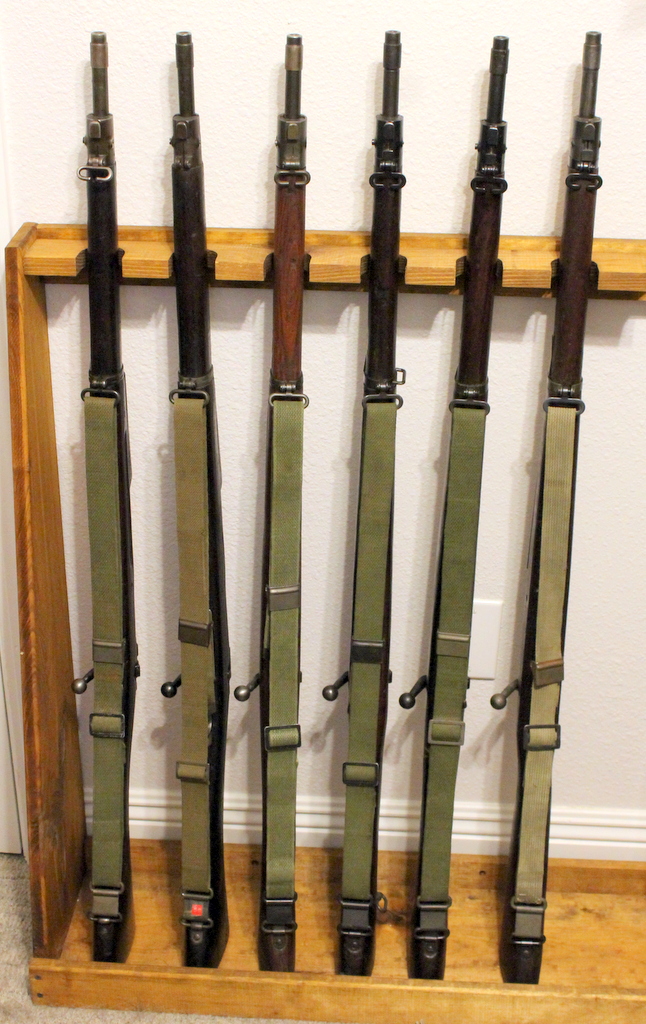
And now it's home with it's kin, shown center left here, with two 1903's to it's right and three 1903A3's to it's left.
I confess to having an affinity for these rifles, even over the M1 Garand, but that puts me in good company, Lewis B. "Chesty" Puller thought the 1903 was more accurate and an all-around better infantry rifle, at least as far as his Marines were concerned.
Older one, too. Serial number puts it at 1907 manufacture.
Has a newer barrel though. Barrel dates to February, 1933.
No hatcher hole on the left side.
New barrel and old parkerized finish suggests a World War Two-era rebuild, not uncommon to 1903 rifles. It also unfortunately saw a scope mount courtesy of some bubba at some time, but it's been repaired pretty decently and it's not nearly as obvious as this photo makes it out to be.
The barrel rifling is strong and sharp, and I bought this one to be a shooter--a 1903 that I can take to the range and enjoy without worrying about putting more wear on it. So those repaired scope holes won't bother me a bit.
Walnut stock has the faint remains of an FJA (Frank J. Atwood) acceptance stamp and a Springfield Armory rebuild stamp.
Sanded and refinished obviously but still would have been a decent stock for a "shooter" 1903 except for the fact that it came cracked.
Yep. That goes all the way though at the wrist. Can't shoot this one.
I saw this as soon as I un-boxed it. I then rechecked the pics that the seller sent me and I couldn't discern any cracks in those pictures. I checked the box that the rifle came in, and while there were some creases in the box that could suggest rough handling, it wasn't really dispositive one way or the other.
I contacted the seller and we went back and forth a bit He swears it wasn't like that when he sent it and he struck me as a decent sort so I tend to believe him and lean towards blaming UPS. I suggested that he initiate a claim with UPS but in the end, the seller just refunded enough of the purchase price to make me feel ok about the stock. On the plus side, stay tuned for a future blog post on how to do vintage rifle stock repairs. I'll try it. And if all else fails, I think I've located an adequate replacement stock and it's on order already, as a spare if nothing else.
The top rifle is the Winchester Model of 1917 that I picked up about a year ago, literally in pieces, after someone fired an 8mm Mauser round through it and blew it to bits. I rebuilt the bolt and replaced the magazine floorplate and ejector, all of which had been damaged in the "Ka-boom" that resulted, and then I cleaned up the stock. She looked good but didn't shoot all that well until I noticed that the rear sight assembly was bent slightly out of alignment too. I finally fixed this the other night with some carefully applied heat and pliers and got it all lined up again like it should be.
The second one is the Rock Island-produced Springfield Model of 1903 that was literally delivered as we were loading the truck to move me from West Virginia to here back in March. It came off the UPS truck, got passed around by my volunteer helpers, then went right into the gun trailer. Today was it's first time out.
At one hundred yards from the prone, the 1917 was ringing the 8" steel about two shots out of three once I got it zeroed. I could definitely have done better had I put a sling on it but even using the peep sight I had to hold under just a bit to nail the steel as the peep is supposed to be 200yrds+. Still, she gave a good acounting of herself when I did my part and come the zombie apocalypse/post-Clinton revolution, I'd put this one on the line.
Next up was the Springfield.On this one, the ladder sight gave me a bit more negative elevation and I was able to set it up for 100 yards perfectly. It also has a much smaller peep and a finer front post and it put every shot on the steel unless I doofed the round, which I did a couple of times. THIS rifle I would not only fight with, I'd take it to Camp Perry.
And as side fun, I was shooting next to a young couple with an AR, and the poor guy was doing his best to hit the steel but couldn't quite pull it off even though he had it on a rest on the bench. The he started smack-talking his rifle, telling his wife/girlfriend that ARs really aren't made for that kind of accuracy. (???) Naturally I made it a point to call out to the RSO and ask rather loudly if they didn't have anything smaller for me to shoot at. "Those huge steel plates down there are making it too easy, even with these old antiques!"
I think the wife/girlfriend was digging me after that.
Neat side-note history-wise on these two. At the beginning of World War One, the main US infantry rifle was the 1903 Springfield. They were made at the two government arsenals at Springfield, Massachusetts and Rock Island Illinois. Production was so low however, that when we finally decided to get into the war in 1917, we didn't have enough of these and could not make enough. However, Remington and Winchester had just finished a contract to make Pattern 1914 rifles for the British and they were still tooled up at their plants and at the Eddystone, PA plant owned by the Baldwin Locomotive Works and leased by Remington for rifle production. A few changed were made to change the Pattern 1914 over from the British .303 cartridge to the American .30 round, and enough rifles were churned out to equip the US Army for the duration as the main WW1 rifle, with the 1903s being kept stateside for training or issued to the Marine Corps, who loved them.
After the war, there were still many more Model 1917s in inventory than there were 1903 Springfields, and a Ordnance Board convened to decide which one to keep as the US standard. And they chose the 1903, because the 1917, while a damned good rifle, was still thought of as "that British rifle" and "not invented here". So the 1917s went into reserve storage and stayed there until World war Two came along, at which time they were brought out for lend-lease and home guard use. Ironically, the 1903s had just been replaced again in Army hands by the new M1 Garand and the Marines were still fielding the '03s. (Mine likely is a Marine Corps gun, based on it's finish and Hatcher holes drilled in the receiver.) But both rifle types served honorably in both world wars, and I'm happy to have a couple of each in my humble collection.
Or rather, last gun from old home, as the UPS truck that brought it came while we were loading the trailer to come here.
I got this on that day:
I'd negotiated it's purchase just a few days prior, with a requirement that it had to arrive before I left. It just made it. Really all I had time to do was look it over briefly and then re-pack it for the trip down here. And it came back out of the box for the first time today.
It's a 1903 Springfield, this one manufactured at the Rock Island Arsenal in Illinois.
The serial number puts it's production date as being early 1913, which coincides perfectly with it's December, 1912-dated barrel.
Yep. A virtually un-messed-with original pre-WW1 rifle. I was pleased.
Of course it had a few indications of having gone around the block a time or two. For instance, the stock, while appearing correct for the rifle, bears a slight "FJA" cartouche, indicating that it was inspected during the reign of Frank J Atwood (1941-1944).
That suggests that the stock was probably on a World War Two-produced 1903A3 first. Likewise, the rifle came with a stamped trigger guard that was used on 1903A3 rifles.
Well the stock was no big deal, but that stamped trigger guard had been irking me since I saw it during my two-minute inspection the day it arrived. Fortunately I had a period-correct milled trigger guard assembly handy, so now it looks like it should again.
And of course it still has that really slick rear sight that helped countless soldiers and marines really dial these puppies in in two world wars and several "Banana Wars" in between.
Not sure when I'll be able to get it out to a range, but if it shoots half as good as it looks, I'll have no complaints whatsoever. (And yes, I know that it's a "low number" rifle and some people don't consider them safe to shoot. The Marine Corps kept them all despite that claim and shot them without any qualms and this one's lasted this long so I figure that it'll be just fine with USGI ammo.) It's not going to be a regular shooter but it will get shot. Meantime, it's residing in one of the gun safes until I can get some new display racks set up in the new gun room.
So on my first actual day off in two weeks, I figure it's range time!
Took the Springfield Armory M-1A out to try out a new load I'm working up.
Survey says:
Seated off-hand using just the web sling, this 100-yard group is more than acceptable. And velocities are pretty consistent, so even though they are about a hundred feet per second faster than NATO spec, I think I'll go with it.
Then I got home and found notice from the Post Office telling me that they had a box for me. A big, ong box.
Oh joy, oh joy!
I went up there and got my newest restoration project...and this one is going to keep me busy for a few weeks.
First out of the box were these parts:
Not good, huh? That's the remains of an extractor, extractor collar, bolt catch box and magazine floorplate assembly. Someone reportedly fired an 8x57mm round through this rifle recently. And this would not have been a problem except that the rifle was one of these:
See the problem, folks?
Many of you are now facepalming over this, but for those of you who don't recognize it, it's a US Rifle Model 1917, chambered for .30-06, aka 7.62x63mm.
Yeah. Ouch. One of those situations where the wrong-sized round will chamber but destroy the rifle and potentially injure the shooter when fired. I am not aware of the status of the one who erred in this fashion but I now have the rifle and am going to try to rebuild it and clean it up.
Metal finish shows neglect and the wood's solid but kinda sad, so some work with sandpaper and ye olde linseed oil should clean the wood up nicely. The metal will get worked over with RB-17 and lots of light steel-wooling. None of the above-pictured small parts are salvageable save the magazine follower and spring.
The bolt catch box got it, too, sure sign of a bolt coming back fast and hard.
The ejector seems to be ok but considering the force that it was just subjected to, I'll replace it too since I'm already in there.
These old rifles were tough, which is why so many of their actions were used for magnum-caliber projects when they were surplussed out of military service after the Second World War. But they served well in that war and in World War One, where they were America's main infantry rifle, outnumbering the 1903 Springfields that they were meant to supplement. You see, when President Wilson took us into that war that he campaigned on keeping us out of, we were so short on Springfield rifles that we had to scramble to find something else to arm our newly-drafted army with. Fortunately private arms companies Winchester and Remington had just completed a contract manufacturing Pattern 14 rifles for the British and they still have the machinery and tooling. The Pattern 14 was chambered for the .303 cartridge but it didn't take much to re-tool to make the same rifle only in .30-06, and soon they were flowing out of three factories: the Winchester and Remington plants and the Baldwin Locomotive Works plant in Eddystone, PA., which was actually owned by Remington.
Model 1917 (top), Pattern 14 (bottom).
Most US Army troops went overseas with the Model 1917 and they saw tough service in their hands, including this guy:
Sgt. Alvin C. York, a conscientious objector from the backwoods of Tennessee who nonetheless went to war when the draft board refused to recognize his particular church. He distinguished himself by leading an attack that killed 25 Germans, captured 132 others and silenced 35 German machine guns. And he did it with a Model 1917.
The Marines kept their '03 Springfields though. And when the war was over, the Model 1917 was relegated to the warehouses while the Model 1903 continued on as "the" American service rifle.
US Rifle Model 1903 Springfield
This particular Model 1917 was manufactured in March of 1918 per the Civilian Marksmanship Program's definitive article on the rifle, and the barrel is dated February, 1918, which would be correct for a March-manufactured rifle. It may very well have done some time "over there" fighting the Boche, but it's here now and if I can salvage it, I'll be proud to add it to the collection.
I got the two restoration projects out to the range yesterday.
Top is the Canadian #4 Mk1 Enfield, and the lower one is the Remington 1903A3 Springfield.
Both shot very well, with the Enfield breaking sporting clays at 50 yards and easily holding "minute of paper plate" wonderfully at 100 yards. It helps that it has a VERY light trigger that almost breaks if you blow on it hard. I think that if I put one of the micrometer sights on it instead of the battle sight, I could get some serious long-range accuracy out of it. We'll see if I can find one of those sights cheap.
As for the Springfield, it was shooting awesome groups at 100 yards, only it was hitting 6-8 inches left, placing them just off the plates I was shooting at. A close examination of the rifle showed me that the rear sight base had drifted left somehow, probably back when it was still a drill rifle. This was easily fixed once I got it home since there was an alignment mark on both the sight base and the receiver and I just had to use a hammer and brass punch to move it back. It didn't really want to move, so it took some hammering, but that's good as hopefully it will not want to move back out of position again.
It was a good range session, if short, except for the fact that it was ridiculous hot out there.
About six years ago, I rebuilt this 1903A3 from parts on a reactivated drill rifle receiver.
But I was never happy with the way that it shot, mostly due to the plastic stock I'd put it in which didn't fit all that well, causing accuracy to fall off, and because of a damaged rear sight that refused to hold it's elevation setting, dropping to the bottom of the ramp with every shot.
For six years, it languished in the rack as a non-shooter. A year or so ago, I got some repair parts for the sight and spent a frustrating evening trying to get those tiny pieces and parts into the right alignment in the old sight base. Just add that to the list of gunsmithing jobs that I don't want to try again soon, ok?
I still did nothing with the rifle, meaning to clean it's wood stock up but never getting around to it. Well last week, when I was working on the Long Branch Enfield and had the linseed oil out, I decided to take a whack at the '03A3 stock too. I sanded it down and prepped a new handguard that I'd bought for it since it never had one when I got it, and I oiled them up when I finished the Emfield wood, mainly as a practice project. I figured that if I messed it up, no big deal.
I did not mess it up. It came out beautifully.
Click on the pics to enlarge.
I'd always thought it a shame that this rifle was just sitting around in that crappy plastic drill stock I'd put it in. It was the total "ugly duckling" of the gun room. But it's not ugly any more.
Got a Remington 1944 barrel that gauges like new on both ends.
When I bought it, the rifle was just a collection of 1903A3 parts fitted to an old 1903 receiver, built as a training aid for a state hunter safety course. It couldn't shoot and wasn't supposed to, but once I figured out what I had, I pulled it apart, sold off the old 1903 receiver (after using it as an office paperweight for a year or so) and mated the parts to a new 1903A3 receiver that I got from Gibbs Rifle Co. in Martinsburg, WV. I even got to drive over there and choose a Remington receiver to match the barrel.
I had the receiver cleaned up and the barrel installed and headspaced by a local gunsmith who is a retired Marine Corps Armorer and the only indication that it was once a drill rifle is the shiny spot by the magazine cut-off where a weld used to be.
A new cut-off and bolt were added and it now functions nicely and looks good sitting in with it's brothers.
Second from the right.
It's still missing a rear sling swivel that I somehow lost while the rifle was disassembled for so long, but that's on order along with the new Long Branch parts, and come Monday I should have everything I need to make both of them 100% again. Meanwhile, first chance I get, this 1903A3 is going out to the range for a proper "Welcome Back" shooting session.
I went out to run a few errands, and while out, I saw this sign for a political candidate.
I'd like to help the guy out, but for one thing, I don't know anything about him. And aside from that, I already pledged my vote to Mike Nesmith. Sorry Davy.
(If you don't get the joke, ask your parents, kid. And get off my lawn.)
Then I saw this in the parking lot at the drug store.
Welcome to West Virginia.
Then it was out to the range to play for a bit with an old friend, a Remington-produced Springfield 1903A3.
This one hasn't been out of the safe in years, but it shot quite well indeed at a hundred yards today--well enough to make me feel guilty for not taking it out more. I used to shoot this one in the Springfield matches at Camp Perry, and I got it from the CMP back when they had a big batch of small arms back from Greece. I bought several Springfields out of that batch, but most went away when I needed money after losing the leg. This one I kept though, and after shooting it today, I remembered why. It's got the black Greek park job but it shoots great.
Hundred yard target. Ammo used: some 16 year-old reloads made with 150gr. pull-down bullets and surplus powder. This target is only 12" wide and 18" high, and I shot it from a seated position at a bench--no rest or sandbags. The shot at the bottom left was the first shot fired, follwed by two of those low 8-ring hits, but after a couple of sight tweaks, I got it pretty much where I was happy with it--the 9-ring is six inches high by 4 inches wide and most of them went there when I did my part. The orange center is just visible to my eye at that distance. (No excuse for that 7-ring hit at 3 o'clock--I wanked that one.) And the head shot was my last round, just to do it.
I also finally found out what happens when an upside-down primer gets missed during post-reloading inspection and winds up in your pistol. I was shooting my 1911 when suddenly I heard the light "snap" sound of a squib load. I dropped the mag and cleared the pistol, expecting to find an empty case in the chamber and a bullet lodged somewhere in the barrel, but when a whole round ejected, I picked it up and saw that the primer was in the pocket backwards. The firing pin still set it off, but of course it didn't fire the powder charge. Bag of ammo loaded in 2006; that round sat around for most of a decade waiting to trip me up. And THIS is why I don't use reloads for street carry.
Still a happy day though. And confirmed with the range that the blogshoot next Saturday is still good to go, including Keads' bowling pin shoot.
Several people seemed to find yesterday's post on the Pattern 1914 rifle interesting, so I figured that I'd expand on it a bit and highlight the American version, the US Rifle, Model of 1917, and it's partner in WW1 warfare, the venerable 1903 Springfield.
Come World War One, the British found themselves in a bit of a fix. They were off to war against that whacky Kaiser Wilhelm but they were sorely lacking in infantry rifles. They were then using the Enfield #1 Mk3, "SMLE" (Short Magazine, Lee Enfield", or "Smelly" to the troops) but they didn't have nearly enough of them.
SMLE in .303
So the Brits turned to the US Arms Manufacturers Winchester and Remington and gave them a design for a rifle that had showed promise in trials but not gone into production for lack of available manufacturers. This rifle was the Pattern 14, a rifle that was considered more accurate and robust than the SMLE but which was also heavier and limited by it's five-round magazine against the SMLE's 10-round capacity. Pattern 14 rifle in .303
Winchester made these at their plant in New Haven, Connecticut and Remington cranked these rifles out at two plants, it's main plant in Ilion, New York, and a second plant that it set up in the Baldwin Locomotive Plant works in Eddystone, Pennsylvania just to make these rifles. They made them up until 1917, at which time the Brits figured that they had enough SMLE rifles and cancelled the contracts. But then the US, feeling left out, got into the war. Not surprisingly, we needed more rifles than we had, too. Our own government arsenals at Springfield, Mass. and Rock Island, Ill. were turning out 1903 Springfield rifles as fast as they could but it wasn't enough to arm the new troops that we were drafting.
US Rifle Model 1903
Fortunately, the Winchester and Remington plants were still set up to produce Pattern 14 rifles, so the design was changed a bit to chamber the rifles in .30-06, the US cartridge that the '03 Springfield was already using, and they were put into production, this time as the US Rifle, Model 1917.
Model 1917 (top), Pattern 14 (bottom).
So our troops went to Europe with not one rifle, but two. The 1903 Springfield is the one often remembered at the predominant World War 1 rifle by many, but in actual fact, more US soldiers were armed with the Model 1917s. Even Hollywood got it wrong when they made a movie about World War One Medal of Honor recipient Alvin York. His heroics were portrayed in the 1941 movie Sergeant York, which featured Gary Cooper in the title role, shown here shooting his newly-issued 1903 Springfield rifle.
In reality, York carried a Model 1917.
1903 Springfield (top), Model 1917 (bottom).
Given a choice, our troops tended to prefer the 1903 Springfield. It was shorter, lighter, and had much better sights that were fully adjustable for windage and elevation. A shooter who knew how to use them could put hits on targets at remarkable distances.
1903 rear sight.
By contrast, the Model 1917 and Pattern 14 were only adjustable for elevation, and while the SMLE had a windage adjustment, it was still pretty crude.
Pattern 14 rear sight. Model 1917 rear sight is identical.
Enfield #1Mk.3 SMLE rear sight.
It was with those 1903 rifles and their long-range marksmanship skills that the US Marines established themselves as a force to be reckoned with in their engagement with the Germans at Belleau Wood. The Germans could not believe that riflemen could pick their machine gunners off at 800-1000 yards as the Marines regularly did with their Springfields.
Post-WW1, the Pattern 14 and Model 1917 were declared obsolete and sold off or stored. They'd be back by necessity in World War Two when the British, desperate for rifles again, re-issued their Pattern 14's to Reserve and Home Guard troops right alongside Model 1917s that the US sent under provisions of the Lend-Lease act. Owing to the difference in cartridges that the two fired, the 1917s had to have big red bands painted on the stocks to clearly identify them as .30 rifles, not .303. The 1903 Springfields soldiered on, remaining a front-line rifle with the Marine Corps. and even some Army units well into the Second World War. An updated version of the 1903, the 1903A3 Springfield, saw that war to a conclusion and even served into the Korean War as a sniper rifle.
Mine have some noteworthy markings that tell a bit about where they've been and what they've seen. My Model 1917 was made at the Eddystone plant in Pennsylvania.
It's barrel is dated 1918, and that's consistent with the serial number. It also shows a stock stamping "RA-P" with indicates an overhaul at the Raritan Arsenal in New Jersey, probably post-WW1.
It also bears the US Ordnance Dept. acceptance stamp, a small flaming bomb, on the receiver and the barrel.
My Pattern 14 was also made at the Eddystone plant, but it's receiver marking is a bit plainer.
On it's receiver rail, it has the British acceptance mark--a crown and the letters G.R. for Georgius Rex--King George. Just ahead of that is a broad arrow stamp, indicating British government ownership.
My 1903 Springfield is a later model, manufactured in 1933 per it's serial number and barrel date.
It also has some faint stock markings that didn't photograph well. The main one of interest is an SAA stamp, which indicates that at some time, this rifle went through an overhaul program at the San Antonio Arsenal.
The SMLE has lots of markings.
It was made in 1916 and the Birmingham Small Arms factory in England. It also bears the Georgious Rex stamp.
It has two serial numbers, the larger one it's British number assigned when it was made, and the lower one an Australian number stamped on it when it was transferred to the Aussie government at some time in it's service life. The D^D stamp is indicative of the Australian Defense Department. This old critter got around.
The stock bears marks as well. The small "639" indicates that this rifle received a new stock in June of 1939, probably when it was being pulled from post WW1 storage and being reconditioned. The stock also has both the rifle's original serial number and the Australian Dept. of Defense stamping.
I'm guessing that it served with English forces in the First World War and the Australian forces in the Second. Bet it's got some stories to tell.
I regularly shoot all of these rifles and find them all to be perfectly sound and accurate after all of these years. All will put rounds nicely on a 200 yard target if I do my part, and I suspect that 1903 in particular will reach out considerably farther. When I get a chance, I'm going to work it in on the 400 yard range and see if I can't ring the steel gong with it a few times.
The 1903 is special to me. I actually saved this one from destruction by buying it sight unseen from a kid who'd inherited it from his grandfather and who was going to cut it into a deer rifle. When I met him, it was bouncing around in the trunk of his car, uncased, with the jack and tire iron and a tool box banging into it. I gave him a hundred fifty dollars for it on the spot, gambling that it wasn't some shot-out piece of junk or National Ordnance boat anchor. As it turned out, I did ok.
All of these rifles have history. Each undoubtedly saw service in at least one world war and perhaps a few other smaller conflicts on the side. Each could probably tell some great tales. Each has known many previous owners before me, and I have no doubt that each will survive me in fine shape and pass on to other owners, probably still in 100% serviceable condition. But for now, I'm proud to have them and appreciate the chance to research them and shoot them.