Saw this beauty at Eglin the other day, too.
Looks like any other World War Two-vintage C-47 cargo plane, doesn't it?
You could think that...but you'd be wrong. Look at the left side.
Mini-guns. Three of them. It's an AC-47 gunship, a.k.a. "Spooky", a.k.a. "Puff the Magic Dragon"
These two-decade-old cargo birds really put the beat-down on the bad guys and were total game-changers when they came into use.
You even see one in John Wayne's The Green Berets at about 1:09 into this clip:
I SO wanted to do something like this with my Cessna and my M-60, but for some reason, the FAA has a rule against it.
Showing posts with label DC-3. Show all posts
Tuesday, June 07, 2016
Saturday, June 06, 2015
D-Day. June 6th, 1944. The day that America came calling on France.
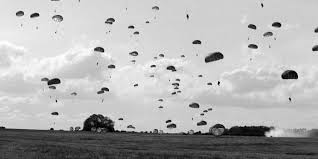
On June 6th, 1944, 13,100 paratroopers from the 101st and 82nd Airborne Divisions dropped into Occupied France, departing their C-47 aircraft from roughly 700 feet above the French countryside.
These troops were quickly followed by 4,000 more troops in gliders.
It was the beginning of the invasion of "Fortress Europe", and it's success spelled the end for Hitler's Third Reich.
To these men, Europe owes it's liberty today. The world owes them it's gratitude.
800 C-47 aircraft were required to lift them all over there and land them where they needed to be. 800 aircraft trying to fly in marginal weather, with no radios or radar, and often without even a trained navigator aboard. It's a miracle that so many of them made it. Not all did.
And just recently, researchers discovered the C-47 that led all the rest over the English Channel that morning. C-47 s/n#42-92847, with the message "That's all, Brother" painted on it's nose as a message for Hitler, was the lead plane that morning, carrying a belly full of 101st Airborne troops.
She returned to England and picked up an 82nd Airborne glider and towed that back across next. Remaining in service, That's all, Brother also flew support for Operation Market Garden, the relief of Bastogne during the Battle of the Bulge, and the crossing of the Rhine River. Here was a plane that saw the invasion of France and the march on Berlin start to finish.
After the war, 42-928427 disappeared in the surplus sale market. No one knew what it had done or where it had been, and it passed through 16 civilian owners before it finally wound up in an airplane scrap yard in Wisconsin. There, a company was planning to strip the airframe and convert it to a turboprop cargo hauler for use overseas, and the aircraft was just weeks away from this fate when it was tracked down by researchers and it's conversion was halted. Now, the Commemorative Air Force is trying to buy this piece of history to restore it to it's original D-Day configuration and fly it around the country so that people today can experience a little bit of what it was like on that morning in 1944.
They've got a kickstarter campaign going now to raise the money needed to purchase this aircraft from the salvage yard. I'm throwing a few bucks their way. If you've got a dollar or two to spare, I'd be hard pressed to recommend a better use for it.
Save That's All, Brother.
And bless the men who flew her and the boys who flew on her enroute to saving Europe and defeating the Nazis.
These troops were quickly followed by 4,000 more troops in gliders.
It was the beginning of the invasion of "Fortress Europe", and it's success spelled the end for Hitler's Third Reich.
To these men, Europe owes it's liberty today. The world owes them it's gratitude.
800 C-47 aircraft were required to lift them all over there and land them where they needed to be. 800 aircraft trying to fly in marginal weather, with no radios or radar, and often without even a trained navigator aboard. It's a miracle that so many of them made it. Not all did.
And just recently, researchers discovered the C-47 that led all the rest over the English Channel that morning. C-47 s/n#42-92847, with the message "That's all, Brother" painted on it's nose as a message for Hitler, was the lead plane that morning, carrying a belly full of 101st Airborne troops.
She returned to England and picked up an 82nd Airborne glider and towed that back across next. Remaining in service, That's all, Brother also flew support for Operation Market Garden, the relief of Bastogne during the Battle of the Bulge, and the crossing of the Rhine River. Here was a plane that saw the invasion of France and the march on Berlin start to finish.
After the war, 42-928427 disappeared in the surplus sale market. No one knew what it had done or where it had been, and it passed through 16 civilian owners before it finally wound up in an airplane scrap yard in Wisconsin. There, a company was planning to strip the airframe and convert it to a turboprop cargo hauler for use overseas, and the aircraft was just weeks away from this fate when it was tracked down by researchers and it's conversion was halted. Now, the Commemorative Air Force is trying to buy this piece of history to restore it to it's original D-Day configuration and fly it around the country so that people today can experience a little bit of what it was like on that morning in 1944.
They've got a kickstarter campaign going now to raise the money needed to purchase this aircraft from the salvage yard. I'm throwing a few bucks their way. If you've got a dollar or two to spare, I'd be hard pressed to recommend a better use for it.
Save That's All, Brother.
And bless the men who flew her and the boys who flew on her enroute to saving Europe and defeating the Nazis.
Labels:
aircraft,
D-day,
DC-3,
military,
World War Two
Tuesday, November 04, 2014
A trip to the Mid-Atlantic Air Museum
This past Friday weather looked good for flying, so Aaron and I took off and headed northeast to visit the Mid-Atlantic Air Museum in Reading, PA.
The flight into Reading was uneventful and took about an hour and a half under some low clouds. My camera was close to dead so I got no in-flight pictures, but when we landed at Reading and taxied over to the FBO adjacent to the museum, we got plenty.
They have this wonderful P2V Neptune there, which actually flies, or at least used to and might again with a bit of TLC.
An old Anti-submarine warplane that pre-dated the P-3 and S-2, a few still soldier on today as fire-bombers. I saw another one at the Pima Air and Space Museum in Arizona this summer. This one is in better shape though.
Supposedly they still fly this one to airshows a few times a year.
Here's a DC-3 that supposedly flies, too.
And a P-84 that doesn't, and probably never will again.
Pity. Even in decay, she's still got beautiful lines.
Their website claims that this Sikorsky HH-52A still flies, but with the rotors missing, I have my doubts.
As to the helicopters behind it...doubtful they'll ever see the sky again.
Over in the corner though is a Fairchild C-119 "Flying Boxcar".
She looks pretty rough too, but it looks like all of the big pieces are there, at least.
Most of the rest of the outdoor birds are in a condition that just kinda make you want to cry.
But their indoor collection is another matter entirely. Jammed into a way-too-small hangar is an eclectic collection of military and civilian aircraft that would make any aircraft aficionado drool. To start with, you walk in the door and nearly knock yourself out on this Grumman TBM Avenger.
This particular one flew to Thunder Over Michigan this year and we saw it there, but it didn't fly, much to my disappointment.
This one survived to be restored as it was kept in service as a fire-bomber while most of it's brothers were scrapped.
There's a B-25 Mitchell in there, too. It's shoe-horned in tight.
Beneath the wing of the Mitchell sits a beautiful Ercoupe. I thought for a while that I might wind up having to fly one of these since they have no rudder or brake pedals.
They've got a cherry 1944 Aeronca 65-TAC in there.
And they've got an N3N-3 trainer.
They've got a Vultee Valiant that lights my fire nicely.
And an SNJ.
But the hallmark of the collection at the Mid-Atlantic Air Museum is this rare beauty undergoing reconstruction in the back corner:
This gem was recovered in the late 1980's from a mountainside in New Holland, where it had lain since it crashed there in 1945.
It's undergoing a total restoration, (documented here) and when complete, it will be the only flying P-61 in existence.
New motor mount to hold the new engine.
New skin being fitted.
Taking shape nicely. Seeing this warbird rising like a phoenix from it's wreckage was worth the trip here all by itself.
After paying homage to the collection, we hit the gift shop then flew back home, catching a nice tailwind and making it back in about an hour. By the time we got down and put the plane to bed, some of our fellow shooters were letting me know that they were in town for the next day's shoot, so an impromptu gathering was arranged at the local Japanese Steakhouse. It was truly a good day.
The flight into Reading was uneventful and took about an hour and a half under some low clouds. My camera was close to dead so I got no in-flight pictures, but when we landed at Reading and taxied over to the FBO adjacent to the museum, we got plenty.
They have this wonderful P2V Neptune there, which actually flies, or at least used to and might again with a bit of TLC.
An old Anti-submarine warplane that pre-dated the P-3 and S-2, a few still soldier on today as fire-bombers. I saw another one at the Pima Air and Space Museum in Arizona this summer. This one is in better shape though.
Supposedly they still fly this one to airshows a few times a year.
Here's a DC-3 that supposedly flies, too.
And a P-84 that doesn't, and probably never will again.
Pity. Even in decay, she's still got beautiful lines.
Their website claims that this Sikorsky HH-52A still flies, but with the rotors missing, I have my doubts.
As to the helicopters behind it...doubtful they'll ever see the sky again.
Over in the corner though is a Fairchild C-119 "Flying Boxcar".
She looks pretty rough too, but it looks like all of the big pieces are there, at least.
Most of the rest of the outdoor birds are in a condition that just kinda make you want to cry.
But their indoor collection is another matter entirely. Jammed into a way-too-small hangar is an eclectic collection of military and civilian aircraft that would make any aircraft aficionado drool. To start with, you walk in the door and nearly knock yourself out on this Grumman TBM Avenger.
This particular one flew to Thunder Over Michigan this year and we saw it there, but it didn't fly, much to my disappointment.
This one survived to be restored as it was kept in service as a fire-bomber while most of it's brothers were scrapped.
There's a B-25 Mitchell in there, too. It's shoe-horned in tight.
Beneath the wing of the Mitchell sits a beautiful Ercoupe. I thought for a while that I might wind up having to fly one of these since they have no rudder or brake pedals.
They've got a cherry 1944 Aeronca 65-TAC in there.
And they've got an N3N-3 trainer.
They've got a Vultee Valiant that lights my fire nicely.
And an SNJ.
But the hallmark of the collection at the Mid-Atlantic Air Museum is this rare beauty undergoing reconstruction in the back corner:
This gem was recovered in the late 1980's from a mountainside in New Holland, where it had lain since it crashed there in 1945.
It's undergoing a total restoration, (documented here) and when complete, it will be the only flying P-61 in existence.
New motor mount to hold the new engine.
New skin being fitted.
Taking shape nicely. Seeing this warbird rising like a phoenix from it's wreckage was worth the trip here all by itself.
After paying homage to the collection, we hit the gift shop then flew back home, catching a nice tailwind and making it back in about an hour. By the time we got down and put the plane to bed, some of our fellow shooters were letting me know that they were in town for the next day's shoot, so an impromptu gathering was arranged at the local Japanese Steakhouse. It was truly a good day.
Subscribe to:
Posts (Atom)