Showing posts with label World War Two. Show all posts

Wednesday, August 09, 2017

Yeah, there's a song for that...

SO today, August 9th, the Japanese commemorate the bombing of Nagasaki, the bombing that finally convinced them to end the war they'd started. Of course they still see themselves as the victims.


Every time think of it, I recall a song from a particular musical that seems to fit.


Everybody sing:

They had it coming!
They had it coming!
They only had themselves to blame!
If you'da been there,
If you'da seen it...
I betcha you would have done the same!

Friday, April 14, 2017

Adventure time! USS Alabama.

So I skipped work today and headed off to Mobile, Alabama to visit Battleship Park and the USS Alabama, (BB-60).

This beautiful South Dakota class World War Two vet is open to the public and in great shape. Here's the view aft from the bow, looking at two of her three turrets, each of which houses three 16"/45 cal. Mark 6 guns.

Here's one of the projectiles that they fire. 2,700 pounds and accurate out to 21 miles. Nice!

Now THAT is a rifle. Times 3.

Inside the turret...because I go these places for you all.
And look at this breech.
Note the ladder running down behind the breech. On another battleship I won't name, I once managed to get into this shell-hoisting shaft with a little help from a Leatherman tool and descended to the bottle of the barbette, several decks below, my way lit only by a mini-mag flashlight held in my mouth. Best self-guided tour ever! But I was well-behaved on this trip.

Here's a look into the aft turret, which is not as well restored.
Outside the aft turret.

Lots of smaller guns, too. Here's one of the many twin 20mm Oerlikon anti-aircraft guns of the main deck.

Another row of Oerlikons (port side). Once the Kamikaze threat became clear, they were putting these guns everywhere on every ship.

Here's a couple of the twin 40mm Bofors Anti-aircraft gun mounts.


Got lots more pics to post...but I'm tired now and it's past the dogs' bedtime too. More to follow.

Monday, February 27, 2017

An unexpected find indeed.

So I'd been reading this book about Ernie Pyle.
The book had been a gift, and while I'd known a little about Pyle, it really gave me a feel for the man and the tragic side of his life as well as the heroic side we all know--the most-read and most-admired war correspondent of World War Two, if not all time.

The book started with his pre-war life, naturally, and went on to chronicle his movements with our troops as he wrote column after column for the Scripps-Howard newspapers, not about the war per se, but about the men who fought it. Pyle specialized in meeting and writing about the individual soldiers, sailors, airmen and marines that fought the war--everyone from bomber crews to rangers to ordnance corps men...but mostly the common soldiers and rarely if ever the officers.

As I read about his columns, and how much America back home loved them, I got to be wondering if anyone had ever compiled a book of them. I even thought briefly about researching them and putting something together, but then I read on and found out that there was a book of them printed, called "Here is Your War" and it was published in 1943.

After finishing this book, I decided that I wanted a copy of that book as well. I had to read these columns for myself, seventy-plus years later. But I've been busy here and hadn't gotten around to looking on-line for a copy yet. And then today, rustling around the house trying to "rest", I just found this on my book shelf:


I HAD a copy. No idea where or when I picked it up. Probably had it for years. Never even noticed it before. I have over a thousand books. This happens sometimes. But usually it's when I buy a book that looks great only to take it home and find a copy on the shelves already. This is the first time I found one that I wanted before I bought it.

Checking the publishing date inside: July, 1945.
That's just three months after Ernie Pyle, America's most beloved war correspondent, was killed by a Japanese machine gunner on the island of Ie Shima, April 18th, 1945.

Thursday, December 10, 2015

December 10, 1941. A dark day for the British.

On December 7th, 1941, Pearl Harbor gave America and the rest of the world a wake-up call. Until then, many Americans dismissed the Japanese soldiers and airmen as being little more than the caricatures found in the newspapers of the day: they were small, with buck teeth and thick glasses because they had bad eyesight. They couldn't fly airplanes or fight, unless it was against other Asians who were even worse at it, like the Chinese.

The British pretty much shared this opinion, and it cost them dearly on this day in 1941. For as the Japanese were sneak-attacking Pearl Harbor, others had done the same thing at the British base at Singapore, albeit with far less damage caused. The next day, the British Navy detected a Japanese landing force enroute to Malaya, north of Singapore. They quickly sent out a task force comprised of the Battleship HMS Prince of Wales and the cruiser HMS Repulse.
The Repulse was a Word War One vet, showing her age but still quite capable. The Prince of Wales, however, was virtually new, a state-of-the-art battleship. It was thought that these two warships and their four supporting destroyers would be more than a match for anything that the Japanese might try, so off they went to stop the Japanese landing fleet.
HMS Prince of Wales

HMS Repulse

Ideally, the British would have had an aircraft carrier in that task force as well, however HMS Indomitable, while enroute to Singapore, ran aground at Kingston, Jamaica, and had to put into the shipyard at Norfolk, VA for repairs. As a result, she wasn't there when war broke out in the Pacific and the Brits decided to go it without air cover, having apparently learned nothing from the destruction of the German Battleship Bismark, fatally damaged by British carrier-based torpedo biplanes in May of 1941.

Heck, this time the Brits were just going up against the Japanese, right? What could they possibly do?

On December 10th, 1941, HMS Prince of Wales and HMS Repulse were attacked by Japanese torpedo planes and bombers and in less than an hour and a half, both warships--the backbone of the British Naval presence in Asia--were on the ocean floor along with 840 crewmen. Hubris has cost the British dearly that day.

Sir Winston Churchill stated in his memoirs later that never during the course of the war had he received so strong a shock as when he got the phone call telling him that the ships and most of their crews were gone. No one had thought such a thing possible, especially coming from the Japanese.

Sadly for the Allies, the Japanese were just getting started. It was about to get a lot worse.
Wake. Guam. Singapore. Bataan. Corregidor. The Dutch East Indies. Australia...the price of underestimating the Japanese and dismissing them as "unfit to fight" was going to be a high one indeed, and tens of thousands of American, British, Dutch and Australian men were going to pay it with their blood in the coming weeks.

Monday, December 07, 2015

A historic range day

December 7th, 1941.

Not only did a dastardly enemy sneak attack us on a peaceful Sunday morning in Hawaii, but the same little bastards launched a war of aggression against our allies in the South Pacific, specifically Britain, Australia and the Netherlands. We quickly combined our Asian Theater assets with theirs and formed the American-British-Dutch-Australian Command, or ABDA, but it was too little, too late, and the combined navies and air arms of all four nations were quickly and totally destroyed in a matter of weeks. ABDA formally ceased to exist on March 1st, 1942. This was two weeks after the British suffered their greatest defeat in World War Two when Singapore fell to the Japs on February 15. On February 19th, The Japs surprised everyone again with a heavy bombing campaign against the port city of Darwin, Australia, something else that the allied powers thought would never happen.

And it would get worse. Bataan and Corregidor were still on the horizon.

A rifle that might have been there was this one that I shot today.
It's another #1Mk3 Enfield that came from my neighbor down the road a couple of months back. I'd finally gotten around to giving it a rough cleaning and oiling sufficient to take it out to the range. At first glance, you'd see it for a World War One-produced British rifle and suspect that it probably had some Great War time on it. And it probably did, as I doubt that any battle rifle built in 1917 just sat around doing nothing for the next two years. But that's only part of this rifle's story.
When I looked at the stock, I saw this marking.
That's a marking that indicates a rebuild at the Lithgow Small Arms factory in Australia. This rifle was redone "down under" in June of 1947.

A closer look at it's stampings tells a bit more.
The middle marking there is a crown over "GR" over two crossed keys over a "p". This was a British military acceptance stamp that the rifle likely got at the factory originally. Like the receiver marking above, it says that this rifle belongs to King George. Just below that though is a "D" with a broad arrow in the middle. THAT is an Australian Department of Defense acceptance stamp. Clearly this rifle is well-traveled.
The receiver ring likewise has two serial numbers, the first one struck out.
The struck-out one, as I've been told, is it's old inventory control number when it was assigned to Australia's Third Military District (Victoria). (That's what the "3" means.)

The rifle is in great shape, appearance-wise. It's only real flaw is this damaged handguard that I am having difficulty finding a replacement for.

The bore was another matter. The rifle had been stored dirty and fouled for years, if not decades. I spent an hour scrubbing it the night before and got a lot of gunk out, but it was still pretty bad this morning. Hopefully some shooting will help with that.

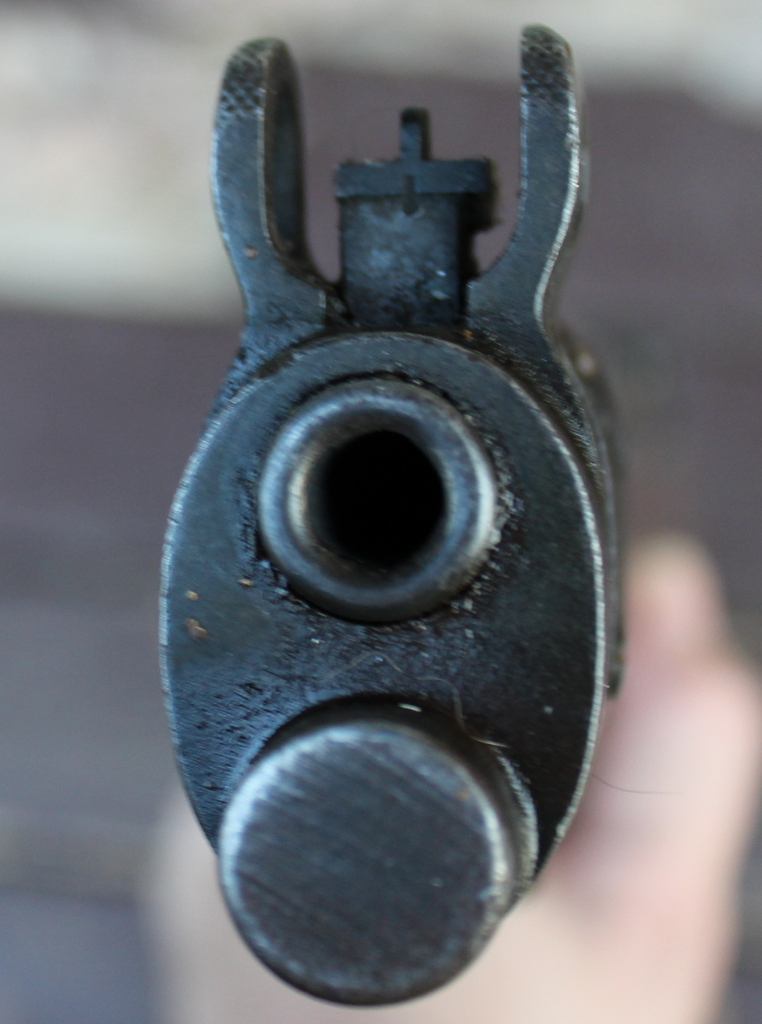
As you can see the front sight was drifted to sight it and it has been marked to indicate where it should be. Not even close to centered, but hey--it's sighted.
I took it out with 50 rounds of 1980mfg. South African .303 ball ammo. It shot them all without a problem, although the cases expanded noticeably. Accuracy was more than acceptable but it did throw some flyers that I don't think were my fault as much as that of a rough or oversized bore. Perhaps it'll do better next time with the .312gr Hornady bullets that I load with now. They've cleaned up a few other sloppy .303 shooters and this rifle might benefit from them too. But it still put every round on target pretty much where I wanted them, and it definitely shot "Minute of German" and probably even "Minute of Jap." Was there a time when this rifle was gripped by a young Aussie as he watched ships burning and sinking in Darwin? Did it go into North Africa for a second run at the Hun following it's British service in the First World War? Sadly, it can't talk and tell it's stories, and the refinishing that it got in '47 cleaned a lot of it's scars away, but it likely wouldn't have needed that rebuild if it hadn't gotten beat up and worn doing something somewhere.

Two World Wars. Maybe Korea. Who knows the real history of this rifle. What I do know now is that it's mine for the time being and it shoots well enough that I'd fight with it if I had to. And that's good enough for me.

Tuesday, September 29, 2015

Battleship Cove

Sunday morning, I flew into Newport State Airport in Rhode Island, to be met by blogger Old Air Force Sarge. He picked me up there, and we were off to Battleship Cove, arriving forthwith, with only a few detours (as in "see it but can't get to it") that he blamed on his GPS, road construction, high taxes and solar flares. Just a guess, but I'm thinking that he wasn't a navigator in the Air Force.

Finally, we got there and walked aboard a fine collection of warships, the first being the USS Joseph P. Kennedy jr., DD 850, a Gearing-class Destroyer.
Here's Sarge checking out the ASROC launcher.
Note that he's standing respectfully outside the red DANGER stripe on the deck. The launcher could and did pivot quite quickly when in use.
Some extra labeling for sailors who didn't quite get it.

Next, we went aboard USS Lionfish, SS298. Lionfish is a World War Two Balao class fleet boat. And as you can tell from prior posts, I loves me some fleet boats.
I'll probably do a whole post on Lionfish later, but if nothing else, let me assure you all that her Dive horn still works. (And I'd have been disappointed had it not.)
(Shown: Green Dive alarm, yellow General alarm (inoperative). Red Collision alarm box is missing.)
But Sarge tells the story better than I can, so I'll refer you to his site for his version of what happened.

It was also someplace in this control room where Sarge cracked his melon on a low-hanging box with sharp corners. Sadly, he didn't give me advance warning so I could video it. Would have been cooler than just hearing the mumbled profanity.

Next, we popped in on the Hiddensee, A Russian-made Tarantul I-class missile corvette that was built for East Germany in 1984 and commissioned Rudolf Egelhoffer. They used her from 1985 through 1990 when Germany was re-unified, and the German Kriegsmarine re-named her Hiddensee before decommission her in 1991. Then they gave it to the US Navy, which used her for five years for testing as USNS Hiddensee before eventually donated her here.
Hiddensee, stern view.
Hiddensee, from the deck of USS Massachusetts.
Not a Dalek. One of Hiddensee's close-in air-defense guns on her stern.
76.2mm main gun.
SS-N-2C missile launcher. Lower missile is on a reloading platform that had to be assembled in place each time a new missile was placed on the tube. When this ship was transferred to the US Navy, the Germans also transferred 170 of those missiles. Wonder where those are now?
Missile launcher, rear view.
Small bridge, with no bridge wings. How does the captain see to dock this boat?
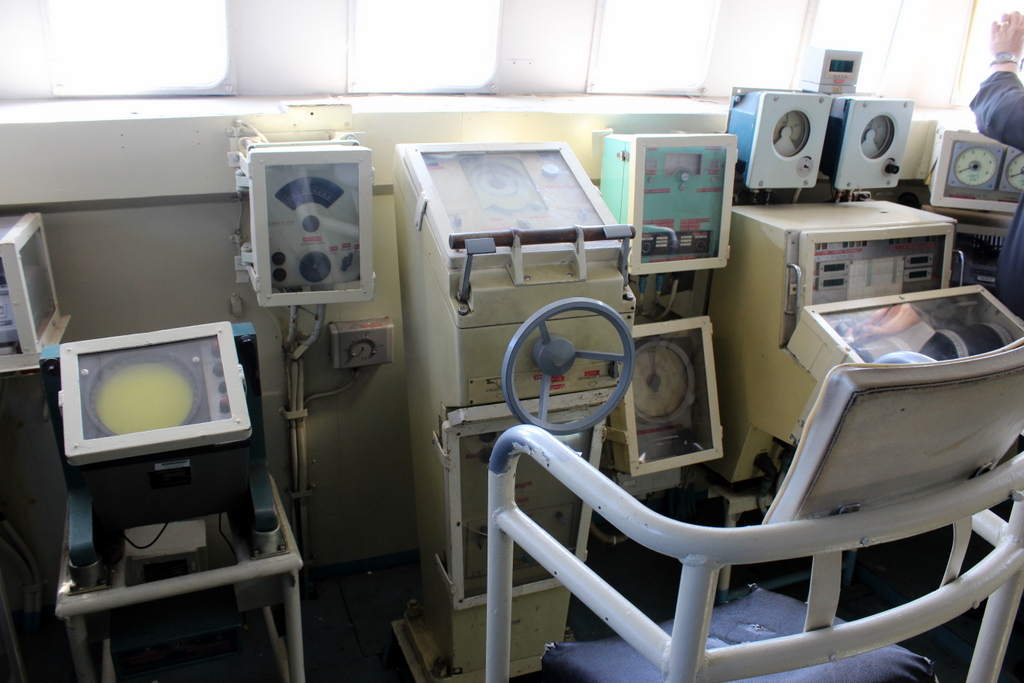
Simple controls, with writing in both Russian and German, and English translations courtesy of a label-maker pasted below the important ones.

When I come back, USS Massachusetts.

Monday, August 10, 2015

Before and After pics--the Enfield Project is complete.

The #4 Enfield Long Branch project is finished.

In a few weeks, it's gone from this:


to this:

All it took was a new stock set and metal, a week's worth of linseed oil application, and a couple hours elbow grease with steel wool and oil on the metal, and a new magazine, and she's all ready to head off to France to refight the landing at Juno Beach, Normandy.

I kept the original buttstock as it was looking fairly decent and because, while I could and did get the stock bolt out courtesy of a new long screwdriver from NAPA, I could not get the buttplate screws out, and I was going nuts trying to sand down the mounting area of the new buttstock to get it to actually fit on the rifle. So I let it keep it's old stock, at least for now. It was definitely a chore to finish-inlet the forestock to get that to fit. OMFG was that a chore. It was too tight at the area where the receiver lugs sit in, and that's a critical-fit area for the #4 Enfield. Take off a bit too much wood and you ruin the fit and accuracy goes out the window.
But I got it finally, and it fits tight and looks good.
The rest of the metal ordered from Sarco wasn't in as good of shape as I would have liked, but then again, it's a closer match for the rest of the rifle's metal, so I won't bitch. I will, however, bitch about the British obsession with weird little screws and proprietary tools that you can't get today, like the one that holds the front sight blade on. There's a handguard band that had to go on just ahead of the receiver and it was originally put on at the factory before the front sight was as the band is a one-piece metal ring. Whoever bubba'd this rifle had cut the old one off, and the new one wouldn't clear the front sight post with the blade installed. Since I had to have it on, and since I could not remove the blade to get it on, I was stuck for a bit. Finally, I carefully bent the ring into an oval shape, allowing it to pass over the blade, and then re-bent it back to proper shape and slid it into place. Got lucky there as it worked perfectly.

It is missing a forward sling swivel, as I somehow managed to leave that off my order list. (Note: before calling a company to complain that they forgot to ship you a part, go back and look at the order form to make sure that you asked for it.) Fortunately I checked before calling Sarco and looking like an idiot. Fault was mine and a new swivel is on the way so that I can mount the new sling that I bought for this rifle. But lack of tat swivel won't keep me from shooting this rifle next Monday when I get some more range time. If she shoots as good as she looks, I'll be happy. For now though, once I quit playing with it, it's up to the Enfield rack in the gun room.

And she'll be in good company here.
From top to bottom: British-made at Royal Ordnance Factory, Maltby, 1941; The Canadian Long Branch, 1944; and a US-made Savage, 1944.