Showing posts with label Wright-Patterson museum. Show all posts

Saturday, June 18, 2011

Wright-Patterson Museum visit, Pt. 8.

I was able to find a few photos that I'd overlooked, and I cleaned up a few others. This will be the last batch in this series, but I'll still have a few other stray shots that I'll post every now and again, so you'll just have to keep checking back if you want to see them.

For starters, here's a Mitsubishi A6M2 "Zero" fighter that was found on Papua, New Guinea after the fighting there was over. Crude in that they lacked armor and self-sealing fuel thanks, they were a lot more agile in the sky than anything that we had at the time. This would change before long, however at the Japanese learned the hard way that it was foolish to underestimate America's resolve and ingenuity...at least back then.

This is the North American A-36 Apache low-level dive bomber. Produced for export to England and powered by an in-line Allison engine initially, it was considered something of a dog and wasn't terribly popular.But then someone came up with the bright idea to ditch the dive brakes and mate it to the Rolls-Royce Merlin engines that were going into the British Spitfires and suddenly the P-51 Mustang was born--an aircraft that would one day be considered one of the best piston-engine fighters ever.


The Bell P-63E Kingcobra is painted up as an RP-63 "pinball" training aircraft developed late in WWII. Aerial gunnery students fired at these manned target aircraft using .30-cal. lead and plastic frangible machine gun bullets which disintegrated harmlessly against the target's external armor plating. Special instruments sent impulses to red lights in the nose of the "pinball" aircraft, causing them to blink when bullets struck the plane.Me personally, before flying on one of those missions I think I'd be checking every student pilot's ammo trays to make sure that it contained the special ammo and not the standard mix of ball, armor piercing and incendiary rounds.

This is a Martin B-26G medium bomber. Not to be confused with my personal fav, the Douglas A-26 (and later, B-26).This little hotrod was known as "the incredible prostitute" because they said, it's wings were so short that it had no visible means of support.

It's a plane...it's a boat...it's a...flying boat. This Consolidated OA-10 Catalina PBY amphibious plane was used for Search and Rescue work, snatching downed American pilots out of the water all around the globe.

It isn't terribly well known, but American forces in World War Two flew a number of foreign-made aircraft. Thei British-made Bristol Beaufighter stands as a prime example. USAAF forces flew over a hundred of these as night fighters, hunting down German raiders that flew after dark.This once apparently scored three Jerries.
This is a British Supermarine Spitfire Mk.V, done up nicely in USAAF colors. These were flown by a number of American pilots early in that war, starting with the Eagle Squadrons made up of American volunteers who joined to fight before America entered the war, risking their US citizenship to do so.
A bit later, the U.S. Army Air Forces' 31st and 52nd Fighter Groups flew them first during Operation TORCH, the invasion of North Africa in November 1942.Behind the Spitfire, over it's wing, you can see the American B-17G heavy bomber Shoo, Shoo Baby.

This is a later variant of the Spitfire, the PR. XI, which is a Mk. XI Spitfire modified for photo reconnaissance.The U.S. Army Air Forces' 14th Photographic Squadron of the 8th Air Force operated Spitfire Mark XIs from November 1943 to April 1945, flying hazardous long-range reconnaissance missions over mainland Europe.
Now these aircraft were just cool. The DeHavilland DH8 Mosquito was made of wood--plywood with a balsawood core. They didn't carry guns but they were light and fast and made excellent photo recon planes and night fighters. The US Army Air Force used a batch of them for both roles.This one's still sporting the black and white invasion stripes under it's wings to let allied gunners on D-Day know that it was a friendly plane.

This is a Kawanishi N1K2-Ja Shiden Kai, otherwise known to Americans as a "George". Coming along late in the war, it was every bit the equal of many of our US Navy fighters and posed a credible threat to our B-29 bomber crews. But it was another case of "too little, too late" and only 400 were produced before the end of the war. This is one of just three survivors left in the world.

I found a usable picture of the museum's other F-100, this one a two-seat F100F used as a trainer and a Misty Forward Air Controller (FAC) plane in Vietnam.This particular F-100F (s/n 56-3837), was a Misty FAC aircraft assigned to the 37th Tactical Fighter Wing at Phu Cat Air Base, Vietnam. It was flown in combat by several notable USAF figures, including Gen. Merrill McPeak and Gen. Ronald Fogleman (former USAF chiefs of staff), and Col. Richard Rutan (the chief pilot of the first around-the-world unrefueled flight).

Yay! A usable shot of the F-105G. This beauty flew combat missions out of Thailand for five years, operating as both a fighter-bomber and a "Wild Weasel" strike aircraft that targeted enemy surface-to-air missile launchers. It also knocked down three enemy MiGs while it was over there. Damn, I love the F-105.
And on the "Bad Guys" side of the ledger, a Mikoyan-Gurevich MiG-21F of the North Vietnamese Air Force.

And just because I've got nothing else for now (but keep checking back), here's a dog wearing a parachute.

But if you still want more plane pics, there are a few here from my visit to Florida's Valiant Air Museum last year.

Wright-Patterson Museum visit, Pt. 7.

The museum has modern aircraft, too. Here's a McDonnell Douglas F-15A Eagle. The F-15 is a twin-engine, high-performance, all-weather air superiority fighter. First flown in 1972, the Eagle entered U.S. Air Force service in 1974. The Eagle's most notable characteristics are its great acceleration and maneuverability. It was the first U.S. fighter with engine thrust greater than the basic weight of the aircraft, allowing it to accelerate while in a vertical climb.
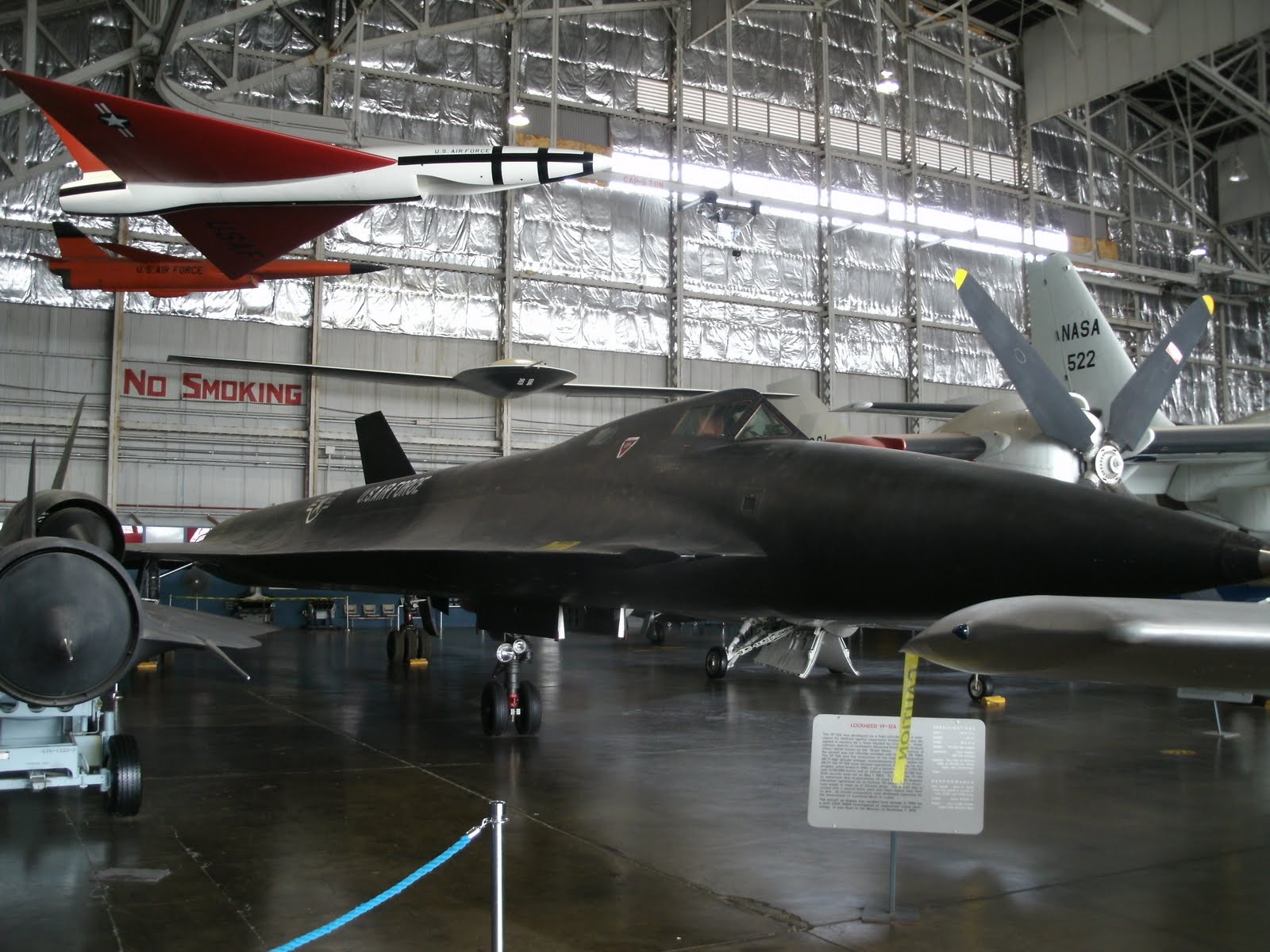
In the Research and Development Annex, they have, among other things, a Lockheed YF-12A. (There's another one inside the main museum...like I said--they've got multiples of just about everything!)
The XB-70 Valkyrie. A Mach 3 supersonic bomber prototype from the 1950's. This is the last one left in the world. Last time I saw this one, the museum was still keeping it outside. I'm so glad that it's under a roof now.
Here's another shot of it, with the Northrop-McDonnell Douglas YF-23A Advanced Tactical Fighter beneath it.

And here's a nose-on view of the North American F-107A, a tactical fighter bomber developed in the 1950's. It never went into production, being beaten out by Republic's F-105.
An F-100C Super Sabre in Thunderbird colors. Too cool for school.

So many great aircraft..and so many pictures that didn't really turn out good enough to post here. One more post tomorrow, and that'll about be that.

Friday, June 17, 2011

Wright-Patterson Museum visit, Pt. 6.

An aircraft that played an important role in Vietnam was the Cessna O-2A, a militarized version of the Model 337 Skymaster. This aircraft was used for Forward Air Control (FAC) duties and it's pilot had to try to mark targets for jet bombers while simultaneously talking to the jet pilots, troops on the ground on a second radio, and air traffic control on a third radio, all while trying to fly the plane and not get shot down by ground troops who knew that the jets couldn't hit them without the FAC.I was actually going to buy one of these several months ago, but someone that I trust helped talk me out of it.
Another holdover from earlier days was the World War Two-designed A-1 Skyraider. This ground attack aircraft was used extensively in Korea because it could carry a lot more ordnance than any jet of it's day, deliver it with more accuracy due to it's slow flight capability, and loiter in the area longer. It was a big plane, which is why I had the big woman in front of it for scale.
OK, she would't move.Air Force Skyraiders in Southeast Asia are probably best remembered for their support of search and air rescue missions. Operating under the call sign Sandy, the A-1's ability to fly over a downed Airman for an extended period complemented its massive firepower. Whereas jet aircraft often had to leave an area for refueling or rearming, the Sandies provided nearly continuous suppressing fire until helicopters could extract downed Airmen.

The A-1E on display (S/N 52-132649) is the airplane flown by Maj. Bernard Fisher on March 10, 1966, when he rescued a fellow pilot shot down over South Vietnam. For this deed, Fisher received the Medal of Honor. The airplane, severely damaged in further combat in South Vietnam, came to the museum in 1967 for preservation.
One of my all-time favorites: The Douglas B-26K Counter Invader. Originally modified from the World War Two A-26, these wonderful aircraft flew day and night ground attack missions along the Ho Chi Minh trail, interdicting supplies that were headed south to kill our troops.
Modified by On Mark Engineering, the B-26K differed from stock A-26 Invaders in that tey had a rebuilt fuselage and tail, strengthened wings, improved engines, reversible propellers, wing-tip fuel tanks and other refinements
Oh--and there's this gun nose, too. Eight forward-firing .50 caliber machine guns made this a wicked aircraft to be downrange of.Some A-26 aircraft are still used in Canada today as firefighting aircraft and are slowly being retired and sold to civilians. I want, I want, I want...
And here's the museum's other A-26, an A26C with the glass bomber nose. This one flew interdiction missions in Korea, mostly at night after the MiGs became problematic.
Often described as a bomber that flew like a fighter, this versatile aircraft served in three major wars and several CIA operations in Africa and the Bay of Pigs.
Dream Girl. Yep. I dream about having one of these in a hangar of my own. Someday, when I hit the lottery...
Another hat. Until I saw this, I had no idea that renowned aviation pioneer Dick Rutan even served in Vietnam, much less that he flew 105 Misty FAC missions.

More to come tomorrow. It's late and I'm tired.

Thursday, June 16, 2011

Wright-Patterson Museum visit, Pt. 5.

OK, since I was asked for this one, here's the Convair B-58 Hustler, a delta-winged supersonic nuclear bomber.
And here's a McDonnell-Douglas F-101 Voodoo.

This is Convair's F-102A Delta Dagger, the Air Force's first delta-winged fighter. It was an all-weather interceptor, tasked with heading off and destroying Soviet bombers coming in from the north. This one was stationed in Iceland and actually came face-to-face with Russian bombers several times.
And here's the Convair F-106A Delta Dart, another interceptor. If it looks a lot like the F-102, it's because it's really just a massive upgrade of that aircraft.
This F-106 has a unique history. When flying over Montana, it went into a flat spin and the pilot, unable to recover, ejected. Once he was gone, probably due to the change in weight and balance caused by the canopy coming off and the pilot leaving, the aircraft straightened itself out and flew off, finally gliding in to a perfect wheels-up landing in a field, causing only minor damage to the plane. It was repaired and flew again before finally winding up here.

Full story here.


And naturally, the museum has McDonnell-Douglas F-4 Phantom jets. This one is an RF-4C, used for photo-reconnaissance.was delivered to the USAF on Sept. 9, 1965. It served in Vietnam, Japan, Korea, Europe, Cuba and the Middle East. During Desert Shield/Desert Storm, this aircraft flew a total of 172 missions, more than any other F-4 aircraft. When flown to the museum in May 1994, it had more than 7,300 hours of flying time.

And then there's this Phantom, another F-4C. But this one has history, too. This was SCAT XXVII, the actual aircraft that then-Colonel Robin Olds was flying when he and weapons system officer Lt. Stephen Croker, destroyed two MiG-17s in a single day on May 20, 1967. Colonel Olds officially destroyed four Migs over Vietnam, and the story of his Air Force career as told in the gripping book "Fighter Pilot" is a fascinating one. If you like good books, I cannot recommend this one enough.

Fittingly, the museum has a small exhibit on Brigadier General Olds.But I still recommend the book.

The museum has Republic F-105s, two. They have a two-seat G model and this single-seat D model below. Sadly, this was the best picture that I could get of either of them. Big sigh. These birds were high-speed, low-level fighter bombers originally designed to deliver nuclear weapons but they wound up being used to deliver large quantities of conventional bombs to every corner of North Vietnam, except, of course, the targets that Lyndon Johnson wouldn't let our pilots hit for political reasons.That's the nose of a Lockheed EC-121D Constellation in the background.

This museum has everything. Planes, weapons...even hats. It seems that someone left his hat behind.

There were also displays set up all through the museum to commemorate warriors who never made it back, like this one recognizing Lt. Karl Richter.He was from Holly, Michigan.

Wednesday, June 15, 2011

Wright-Patterson Museum visit, Pt. 4.

Now it's jet time, beginning with the first real American jet fighter, the Lockheed F-80 Shooting Star. This one actually flew combat in Korea, one of the very few combat vet F-80s still in existence. It was an F-80 like this one that won the first all-jet dogfight over Kroea, knocking down a Mig-15.
OK, it there was any one jet I could have free and clear, it's be the North American F-86 Sabre jet like this A model here. Naturally, Wright-Pat has a few of these, too.
This is the aircraft that, in the hands of superior American pilots, knocked down North Korean Migs at a 15:1 ratio. And here below is that Sabre with it's arch-enemy, the Mig 15.
Here's an F-86D, with a radar unit in the nose. (Note the RB-50 Reconnaissance aircraft in the background.)
And below is an RF-86F photo-reconnaissance aircraft that was used in Korea for overflights of North Korea. The bulges below the cockpit are for the then state-of-the-art "Haymaker" cameras which replaced the guns. It was used by the US Air Force then turned over to the South Koreans. This one was flown by them well into the 1980s--almost thirty years of flying for this particular Sabre. And those "guns" on the nose? Painted on to help it look like it was armed.

And if there was ever a jet fighter that went through more design changes and evolutions, than the Republic F-84, I can't think of it. This bird started out with a straight wing, evolved to a swept wing, some versions had solid noses with the air intakes in the wings, and others, like this F84F Thunderstreak, kept the open nose.In most of it's variations, it was a pretty rugged fighter-bomber, and the Thunderbirds even flew a couple of variants, starting out in 1953 with the straight-winged F-84G and transitioning to the swept-wing F-84F like the one above, in 1955. (And just one year later they switched again, this time to the F-100C. But that one comes later in the postings. This was the first fighter bomber equipped to deliver nuclear weapons.

More to come later. Stay tuned!