Showing posts with label Thunder over Michigan. Show all posts

Wednesday, September 03, 2014

King Cobra Love!

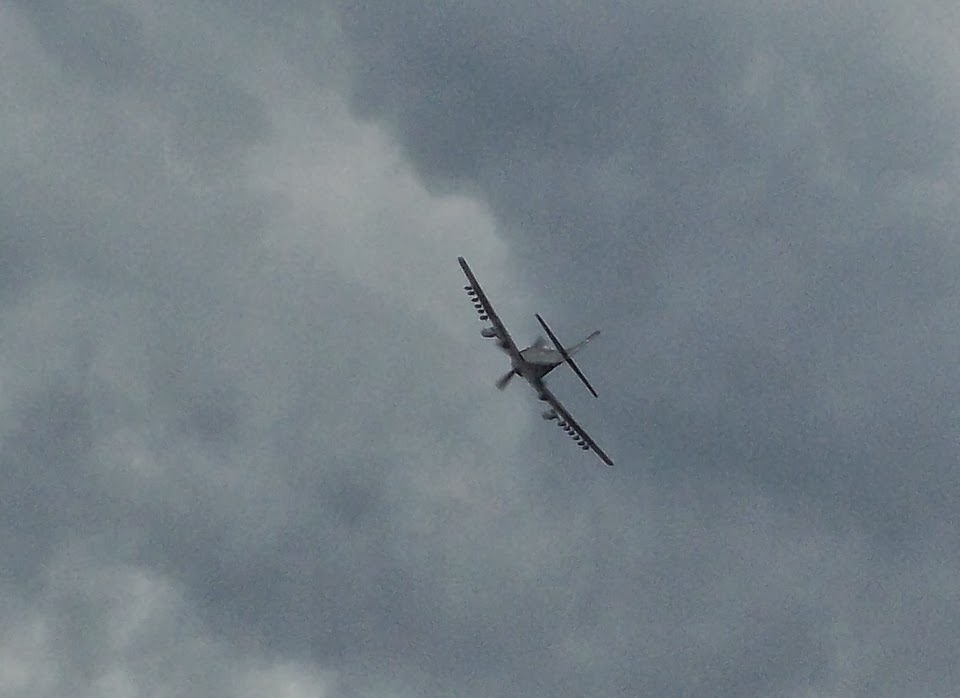
Some nice shots of the Bell Aircraft P-63 King Cobra from Thunder Over Michigan.
This beauty was one of the reasons that I went this year. It's one of the rarest of the flying warbirds, with just a handful left, two out of 3,300 built.
The P-63 looks like the earlier Bell P-39 Airacobra, but it's not one. It's a follow-on design that was intended to correct all of the problems of the P-39. It was bigger and had a supercharged engine that the P-39 lacked. As a consequence, if flew faster and higher than it's predecessor.
Like the P-39, it's armament consisted of two .50 machine guns in the nose that fired over a 37mm cannon mounted behind the propeller, firing through the the prop hub.
It also shared the same cockpit design as the P-39, including automotive-style doors.
The US Army Air Corps ordered this plane, but then chose not to adopt it, so most of the production run wound up going to the Russians under the Lend-Lease program. The Russians, who were already using lots of the P-39s, loved this one.
After the war, we gave most of the rest to the French, who used them in Indochina in 1950-51.
The new USAF kept a few for use as gunnery targets like this one that I photographed at Wright Patterson Air Force Museum a few years back.

This surviving P-63E Kingcobra was modified as an RP-63 training aircraft. Aerial gunnery students fired at these manned target aircraft using .30-cal. lead and plastic frangible machine gun bullets which disintegrated harmlessly against the target's external armor plating. Special instruments sent impulses to red lights in the nose of the aircraft, causing them to blink when bullets struck the plane. Pilots nicknamed these aircraft "pinballs".

Sadly, only four P-63s survive in flying condition today, and less than half a dozen display aircraft still exist. Like so many other fine aircraft types in the post-war days, they were valued more for their metal than their history or abilities. Heck, my grandparents didn't even think to put one away for me when the US government was selling them for a few hundred dollars each.
But at least I got to see this one fly.
A serviceable plane, it's one of the relative few US military aircraft that was never actually used as a fighter by the US Army Air Force. They all went overseas or into use as training aircraft and not one of the 3,300 ever fired a shot in anger in US service.

For more really good P-63 pics, hit Aaron's blog here:

King of the rare birds--the P-63C Kingcobra

Monday, August 25, 2014

Just Plane Cool--The Vultee Vibrator

One of the reasons that I went to Thunder Over Michigan this year was because I hoped to see a Vultee Valiant there. In this, I was not disappointed.
A Valiant is another plane on my list of possibles. They aren't cheap, but they're cheaper to buy and operate than the T-6 Texan, and currently there are two for sale that I know of that I might be able to swing.
The BT-13 was the basic trainer that most World War Two pilots learned on after transitioning from the Stearman primary trainers.
Although it resembles the North American T-6, the Valiant has a few key differences, mainly a smaller 450hp engine and fixed landing gear as opposed to the 600hp engine and retractable gear of the T-6. It also suffers from a wet-wing fuel storage system that's famous for leaking, especially now that these aircraft are seventy+ years old. But this was what the pre-war military wanted, because aircraft like the T-6 or Vultee's comparable V-54 were considered "too expensive" in the late 1930's. Once the war cam,e along, the T-6 suddenly found a new lease on life, but the Valiaint, already in production, continued to be built and bought as fast as they could come off the line.
Over 11,500 of these were built and used, and sadly, all but a handful were eventally declared surplus and sold off after the war for a few hundred dollars each. Most were purchased for their engines, which crop-dusters were mating to surplus Stearmans. The BT-13 fuselages were then cut up for scrap or abandoned. About a hundred survive today and maybe half of that number still fly today.
This aircraft was nicknaamed the "Vultee Vibrator", most likely because of it's tendency to shake violently as it approached stall speed.
The owner of this one was gracious enough to talk to me about it at length, and he even let me try the cockpit out to make sure that I can work the rudders and brakes. (And I can.)
He's owned this one for about ten years and loves it. It's fully aerobatic, but again, it's seventy+ years old so it doesn't get wrung out any more.

I admit that I'm tempted, even though it'll mean selling a lot of stuff and getting used to eating ramen noodles regularly again for a while. And since the O-2A that I was mulling has since been sold to another owner...

Thursday, August 21, 2014

I've got to stop going places where these things are.

Because now I want one again--a Cessna O-2A.
A cooler-than-cool Forward Air Control (FAC) aircraft from the Vietnam War, these old veteran can be found here and there today at reasonable prices and they've been tempting me hard for years.
Usually though, there's someone with common sense (*Koff!* Old NFO, Brigid *Koff!*) to thrw some ice water on my ambitions and talk me off the ledge before I jump. But this time, I met the Guru of the O-2, The A&P Yoda himself who resurrected most of the flying O-2s today from the Boneyard, and he not only talked me back up, but offered to inspect any aircraft that I find and do it's annuals at his hangar in Michigan. Worse yet, he knows the specific ones that I've been mulling and says that one in particular is a phenomenal deal if it's still for sale.

I didn't need that.
A wonderful twin-engine Cessna, this one would make my usual Michigan flights in under two hours, half the time it takes my current 172. It has two 230hp. engines, retractable anding gear, and constant-speed propellers.
It can haul practically anything, is rated for instrument flight, and most of them have Vietnam time in thei logbooks and residual patched battle damage, making them historic as well as practical.
Yeah, I can fly that. Just need my multi-engine rating..


Aaron's got more on it here.


Want, want, want...HELP!!!

Wednesday, August 20, 2014

Tanks for the memories

While up at Thunder Over Michigan with Aaron and The Spud a couple of weeks back, we saw this nifty German Hetzer Tank Destroyer.
The Hetzer was a late-war production tank destroyer made to be small, nimble and hard-hitting. The lack of a turret made it much simpler and lighter, and the 75mm main gun that it mounted would do a number on all but the heaviest Soviet tanks and pretty much anything that the US and Britain put in the field.
These are still found today as many were built and survived the war, and also because after the war, the Swiss bought all of the existing models left from the Allied powers along with the machinery and tooling to make them, which was taken from the Czech Skoda Arms Works. The Swiss then put the old machines and newly-built versions into service as the G-13, and used them up into the 1970s, at which time they were sold commercially. Most of the ones you see rolling around today, like this one, are post-war Swiss machines.
The original German models had gasoline engines which were notably fire-prone and unpopular with their crews. The Swiss re-powered theirs with six-cylinder diesels like this one has today. Both German and Swiss models had a remote-firing MG-42 type gun that could be fired without the operator exposing himself to return fire. This unit has one (below).
It weighs just sixteen tones and stands just seven feet high, and the old German models could scoot along at 26mpgmph. The Swiss with the diesels were actually a few MPH faster. And making good use of sloped armor, it was a pretty tough little nut to crack.
I'm thinking that I could probably use one of these here in West Virginia. And the next time the county raises my tax assessment, I just might have to look into getting one and then "re-negotiating" that tax bill from a position of strength.

Tuesday, August 12, 2014

If I could have but one...

At Thunder over Michigan this year, we saw the plane that, if I could have any one thing with wings, would be in my hangar, at least during those rare moments what I was not flying the wings off of it.
The North American F-86 Sabre Jet--a true thing of beauty, both then and now.
First flown in 1949, these aircraft enabled good pilots to sweep the Korean skies clear of Russian MiGs, and some of the nearly ten thousand built were flown by 29 other countries before the last ones were retired from the Bolivian Air Force in 1994. Fast and agile, they were wonderful aircraft and the few that still fly airshow circuits today are worth going to see.
And here's the business end of the General Electric J-47 engine.
This one is an F-86F, one of the later-produced models.
So how does it fly? Like a dream.


This aircraft I need. When I buy lottery tickets, I'm really just paying a dollar to dream for a few days of having one of these. With operational .50 machine guns, of course.

Sunday, November 17, 2013

Skyraider Love

After Old AF Sarge's wonderful blogpost last Friday where he featured the Douglas Skyraider, I felt compelled to dig into my own modest photo archives and do a post on the same aircraft that Aaron of The Shekel and I saw this past summer at Thunder Over Michigan.

At Thunder over Michigan 2013, there were Skyraiders. Big, beautiful bad-guy-smacking Skyraiders. (click on the pics for close-up awesomeness.)

There was this AD-1.
And this AD-4.
There was this AD-5W four-seater, sitting there looking lethal.
And there was this AD-5W, shown here getting a clean-up in between flights. Got to get all of that soot away from the exhausts.

And they flew, too. Here's one leading a flight of three, with an A-4 Skyhawk on one wing and an F-4U Corsair on the other. radial engine harmony accented by jet roar.
Then the Skyhawk and the Corsair went away, and more Skyraiders came up. All four were flying for a while, and it was beautiful.
Bye!


And yeah, it goes without saying that I need one of these.